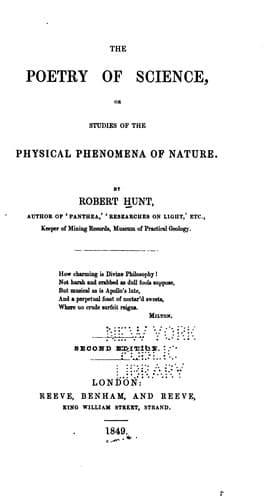
The Poetry of Science; or, Studies of the Physical Phenomena of NatureHunt, Robert
Philosophy
The Poetry of Science; or, Studies of the Physical Phenomena of Nature
Hunt, Robert
Physics; Science
When these rocks were in the progress of formation, there existed the
ichthyosaurus, or fish-lizard, which appears, in many respects, to have
resembled the crocodile of the Nile. It was a predatory creature of
enormous power, and must have been the tyrant and terror of the seas
which it inhabited. Its alligator-like jaws, its powerful eye, its
fish-like fins, and turtle-like paddles, were all formed to facilitate
its progress as a destructive minister. The plesiosaurus was, if
possible, a still more extraordinary creation. To the head of a lizard
was united an enormously long neck, a small and fish-like body, and the
tail of a crocodile: it appears formed for existence in shallow waters,
so that, when moving at the bottom, it could lift its head above the
surface for air, or in search of its food. The flora of this period
must have been extensive; and it resembled the vegetation which exists
at present in Tropical regions.
We pass now to a new epoch, which is well distinguished by its animals
from all that had preceded it. Races of reptiles still have place upon
the earth, and we have now the megalosaurian remains; these animals
possessing a strength and rapacity which would render them objects of
terror as well as astonishment, could they be restored to the world
which they once ravaged. An enormous bat-like creature also existed
at this time--the pterodactyl--which, in the language of Cuvier, was,
“undoubtedly, the most extraordinary of all the beings of whose former
existence a knowledge is granted to us, and that which, if seen alive,
would appear most unlike anything that exists in the present world.”
“You see before you,” says the same writer, “an animal which, in all
points of bony structure, from the teeth to the extremities of the
nails, presents the well-known saurian characteristics, and of which no
one can doubt that its integuments and soft parts, its scaly armour and
its organs of circulation and reproduction, are likewise analogous. But
it was, at the same time, an animal provided with the means of flying;
and, when stationary, its wings were probably folded back like those
of a bird, although, perhaps, by the claws attached to its fingers, it
might suspend itself from the branches of trees.”[235]
From the disintegration of the older rocks have no doubt arisen those
formations which are known as the oolitic series. In these strata are
preserved the remains of plants and animals more resembling those which
now exist upon the earth; and, for the first time,--unless the evidence
of the footsteps of birds on the new red sandstone of America be
accepted,--we meet with the remains of the feathered tribes.
In these formations we discover animals belonging to the class
Mammalia,--the amphitherium and the phascolotherium,--which appear
to have resembled, in many respects, the marsupial animals of New
Holland.[236]
Public-domain text, read in full here on John Shaqi.
Reviews
Reviews
No reviews yet
Be the first to share your thoughts on this work.
Elsewhere in the archive
Join the Discussion
Join the discussion
Sign in to leave a comment or review.
Sign InorCreate an account