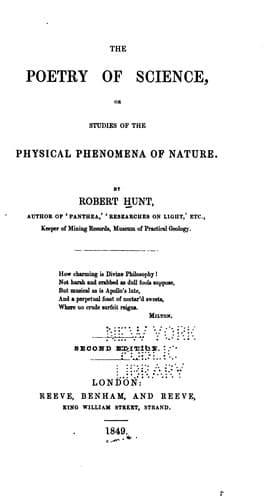
The Poetry of Science; or, Studies of the Physical Phenomena of NatureHunt, Robert
Philosophy
The Poetry of Science; or, Studies of the Physical Phenomena of Nature
Hunt, Robert
Physics; Science
In the world then, as it does now, water acting on the dry land
produced remarkable changes. We have evidence of extensive districts
over which the most luxuriant vegetation must have spread for
ages,--from the remains of plants in every state of decay,--which we
find went to form our great coal-fields. These, by some changes in the
relative levels of land and water, became covered with this fluid;
and over this mass of decaying organic matter, sand and mud were for
ages being deposited. At length, rising above the surface, it becomes
covered with vegetation, which is, after a period, submerged; the same
deposition of sand and mud again takes place, it is once more fitted
for vegetable growth, and thus, cycle after cycle, we see the dry land
and the water changing places with each other. This will be evident
to every one who will carefully contemplate a section of one of the
coal-fields of Great Britain. We find a stratum of coal lying upon
a bed of under clay, and above it an extensive stratum of shale or
sandstone, probably formed by the denudation of the neighbouring hills;
and in this manner we have many strata of coal, shale, clay, ironstone,
and sandstone alternating with each other; the coal-formations of the
South Wales coal-field having the extraordinary thickness of 1500 feet.
The lowest bed of this extensive series must at one time have been
exposed as the surface of the country.
Ascending in the series, we have now formations of a more recent
character, in which fishes of a higher order of organization, creeping
and flying saurians, crocodiles and lizards, tortoises, serpents, and
frogs, are found. The lias formations (a term corrupted from _layers_),
consisting of strata in which an argillaceous character prevails, stand
next in series. In these we have animals preserved in a fossil state,
of a distinguishingly different character from those of the inferior
strata. We meet with extended beds of pentacrinites, some inches in
thickness; and their remains are often so very complete that every part
of the skeleton can be made out, although so complicated that it cannot
consist of less than 150,000 parts. In these formations we often find
the curiously beautiful remains of the ammonites, of which a great
variety have been discovered. Of the belemnites--animals furnished with
the shell and the ink-bag of the cuttle-fish, with which it darkened
the water to hide itself from enemies, numerous varieties have also
been disentombed, with the ink-bag so well preserved, that the story of
the remarkable fossil has been written with its own ink. In addition to
these we find nautili; and sixty species of extinct fishes have been
described by Agassiz from the lias of Lyme Regis alone.
Public-domain text, read in full here on John Shaqi.
Reviews
Reviews
No reviews yet
Be the first to share your thoughts on this work.
Elsewhere in the archive
Join the Discussion
Join the discussion
Sign in to leave a comment or review.
Sign InorCreate an account