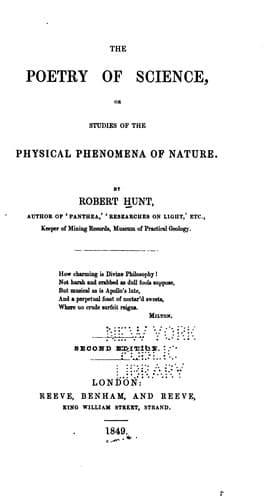
The Poetry of Science; or, Studies of the Physical Phenomena of NatureHunt, Robert
Philosophy
The Poetry of Science; or, Studies of the Physical Phenomena of Nature
Hunt, Robert
Physics; Science
The variety of beautiful forms which cover the surface of this sphere,
serve, beyond the physical purposes to which we have already alluded,
to influence the mind, and give character to the inhabitants of every
locality. There are men who appear to be dead to the mild influences
of flowers; but these sweet blossoms--the stars of our earth--exert a
power as diffusive as their pervading odours.
The poet tells us of a man to whom
The primrose on the river’s brim
A yellow primrose was to him,
And it was nothing more.
But it was something more. He, perhaps, attended not to the eloquent
teaching of its pure, pale leaves: he might not have been conscious
of the mysterious singing of that lowly flower: he might, perchance,
have crushed it beneath his rude foot rather than quaff the draught of
wisdom which it secreted in its cell; but the flower still ministered
to that mere sensualist, and in its strange, tongueless manner,
reproved his passions, and kept him “a wiser and a better man,“ than if
it had pleased God to have left the world without the lovely primrose.
The psychology of flowers has found many students--than whom not one
read them more deeply than that mild spirit who sang of the Sensitive
Plant, and in wondrous music foreshadowed his own melancholy fate.[248]
That martyr to sensibility, Keats, who longed to feel the flowers
growing above him, drew the strong inspiration of his volant muse from
those delicate creations which exhibit the passage of inorganic matter
into life; and other poets will have their sensibilities awakened by
the æsthetics of flowers, and find a mirror of truth in the crystal
dew-drop which clings so lovingly to the purple violet, and draws fresh
beauties from its coloured petals.
If we examine carefully all the conditions of matter which we have
made the subject of our studies, we cannot but perceive how gradual
is the progress of the involved action of the physical forces, as we
advance from the molecule--the mere particle of matter--up to the
organic combination. At first we detect only the action of cohesion in
forming the rude mass; then we have the influence of the crystallogenic
powers giving a remarkable regularity to bodies; we next discover the
influences of heat and electrical force in determining condition, and
of chemical action as controlled by them. Yet, still we have a body
without organization. Light exerts its mysterious powers, and the same
elements assume an organized form; and, in addition to the recognized
agencies, we dimly perceive others on which vitality evidently
depends. These empyreal influences become more and more complicated
to us: ascending in the scale, they rise beyond our science; and, at
length, we find them guiding the power of intelligence, while instinct
and reason are exhibited in immediate dependence upon them.
Public-domain text, read in full here on John Shaqi.
Reviews
Reviews
No reviews yet
Be the first to share your thoughts on this work.
Elsewhere in the archive
Join the Discussion
Join the discussion
Sign in to leave a comment or review.
Sign InorCreate an account