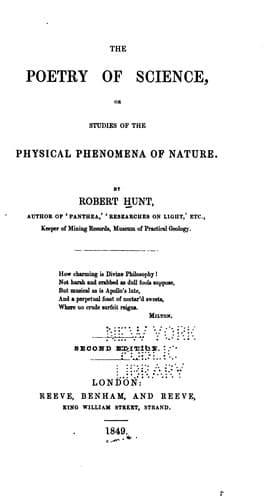
The Poetry of Science; or, Studies of the Physical Phenomena of NatureHunt, Robert
Philosophy
The Poetry of Science; or, Studies of the Physical Phenomena of Nature
Hunt, Robert
Physics; Science
Let it not be imagined that this view has any tendency to materialism.
The vital energy is regarded as a spiritualization, and reason as a
divine emanation; but they are connected with materialities, on which
they act, and by which they are themselves controlled. The organic
combinations, and the physical powers by which these unions of matter
are effected and retained, have a direct action over that ethereality
which is life, and the powers of life again control these more material
forces. The spirit, in whatever state, when connected with matter, is,
like Prometheus chained to his rock, in a constant struggle to escape
from its shackles, and assert the full power of its divine strength.
We have seen variety enough in the substances which make up the
inorganic part of creation; but infinitely more varied are the forms
of organization. In the vegetable world which is immediately around
us, from the green slime of our marshes to the lustrous flowers of our
gardens and the lordly trees of our forests, what an extraordinary
diversity of form is apparent! From the infusoria of an hour, to the
gigantic elephant roaming in his greatness in the forests of Siam--the
noble lion of the caves of Senegal--the mighty condor of the Andes--and
onward to man, the monarch of them all, how vast are the differences,
and yet how complete are they in their respective conditions! In the
creation we have examined, we have had conclusive evidence, that from
the combination of _atoms_ every peculiar form has been produced. In
the creation we are about to examine, we shall discover that all the
immense diversity of form, of colour, and condition which is spread
over the world in the vegetable and animal kingdoms, results from the
combination of _cells_. The atom of inorganic nature becomes a cell in
organic creation. This cell must be regarded as the compound radical of
the chemist, and by decomposing it, we destroy the essential element of
organization.
With the mysterious process by which the atom is converted into a
cell, or a compound radical, we are unacquainted; but we must regard
the cell as the organic atom. It is in vain that the chemist or the
physiologist attempts to examine this change of the inorganic elements
to an organized state; it is one of the mysteries of creation, which is
to be, in all probability, hid from our eyes, until this “mortal coil”
is shaken off, and we enjoy the full powers of that intelligence which
we are promised we shall enjoy in an immortal state.
Again and again has the attention of men been attracted to the
_generatio æquivoca_; they have sometimes thought they have discovered
a _generatio primitiva_ or _spontanea_; but a more careful examination
of these organisms has shown that an embryo existed--a real germination
has taken place.
Public-domain text, read in full here on John Shaqi.
Reviews
Reviews
No reviews yet
Be the first to share your thoughts on this work.
Elsewhere in the archive
Join the Discussion
Join the discussion
Sign in to leave a comment or review.
Sign InorCreate an account