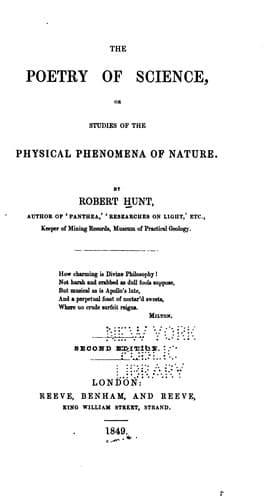
The Poetry of Science; or, Studies of the Physical Phenomena of NatureHunt, Robert
Philosophy
The Poetry of Science; or, Studies of the Physical Phenomena of Nature
Hunt, Robert
Physics; Science
If we take some water, rising from a subterranean spring, and expose
it to sunshine, we shall see, after a few days, a curious formation
of bubbles, and the gradual accumulation of green matter. At first we
cannot detect any marks of organization--it appears a slimy cloud of
an irregular and undetermined form. It slowly aggregates, and forms a
sort of mat over the surface, which at the same time assumes a darker
green colour. Careful examination will now show the original corpuscles
involved in a net-work formed by slender threads, which are tubes of
circulation, and may be traced from small points which we must regard
as the compound atom, the vegetable unit. We must not forget, here,
that we have to deal with four chemical elements,--oxygen, hydrogen,
carbon, and nitrogen, which compose the world of organized forms, and
that the water affords us the two first as its constituents, gives us
carbon in the form of carbonic acid dissolved in it, and that nitrogen
is in the air surrounding it, and frequently mixed with it also.
Under the influence of sunshine, we have now seen these elements
uniting into a mysterious bond, and the result is the formation of a
cellular tissue, which possesses many of the functions of the noblest
specimens of vegetable growth. But let us examine the progress. The
bare surface of a rock rises above the waters covered over with this
green slime, a mere veil of delicate net-work, which, drying off,
leaves no perceptible trace behind it; but the basis of a mighty growth
is there, and under solar influence, in the process of time, other
changes occur.
After a period, if we examine the rock, we shall find upon its face
little coloured cups or lines with small hard discs. These, at first
sight, would not be taken for plants, but on close examination they
will be found to be lichens. These minute vegetables shed their seed
and die, and from their own remains a more numerous crop springs into
life. After a few of these changes, a sufficient depth of soil is
formed, upon which mosses begin to develope themselves, and give to
the stone a second time a faint tint of green, a mere film still, but
indicating the presence of a beautiful class of plants, which, under
the microscope, exhibit in their leaves and flowers many points of
singular elegance. These mosses, like the lichens, decaying, increase
the film of soil, and others of a larger growth supply their places,
and run themselves the same round of growth and decay. By and by,
funguses of various kinds mingle their little globes and umbrella-like
forms. Season after season plants, perish and add to the soil, which is
at the same time increased in depth by the disintegration of the rock
over which it is laid, the cohesion of particles being broken up by the
operations of vegetable life. The minute seeds of the ferns floating on
the breeze, now find a sufficient depth of earth for germination, and
their beautiful fronds, eventually, wave in loveliness to the passing
winds.
Public-domain text, read in full here on John Shaqi.
Reviews
Reviews
No reviews yet
Be the first to share your thoughts on this work.
Elsewhere in the archive
Join the Discussion
Join the discussion
Sign in to leave a comment or review.
Sign InorCreate an account