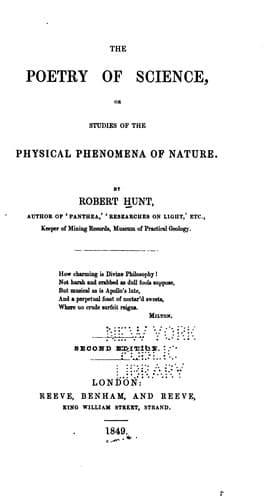
The Poetry of Science; or, Studies of the Physical Phenomena of NatureHunt, Robert
Philosophy
The Poetry of Science; or, Studies of the Physical Phenomena of Nature
Hunt, Robert
Physics; Science
Vegetable forms of a higher and a higher order gradually succeed each
other, each series perishing in due season, and giving to the soil
additional elements for the growth of plants of their own species or
those of others. Flowering herbs find a genial home on the once bare
rock; and the primrose pale, the purple foxglove, or the gaudy poppy,
open their flowers to the joy of light. The shrub, with its hardy roots
interlaced through the soil, and binding the very stones, grows rich
in its bright greenery. Eventually the tree springs from the soil,
and where once the tempest beat on the bare cold rock, is now the
lordly and branching monarch of the forest, with its thousand leaves,
affording shelter from the storm for bird and beast.
Such are the conditions which prevail throughout nature in the progress
of vegetable growth; the green matter gathering on a pond, the mildew
accumulating on a shaded wall, being the commencement of a process
which is to end in the development of the giant trees of the forest,
and the beautifully tinted flower of nature’s most chosen spot.
We must now consider closely the phenomena connected with the growth of
an individual plant, which will illustrate the operation of physical
influences throughout the vegetable world. The process by which the
embryo, secured in the seed, is developed, is our first inquiry.
A seed is a highly carbonized body, consisting of integuments and
embryo: between these, in most seeds, lies a substance called the
_albumen_, or _perisperm_. The embryo contains the elements of the
future plant--the cotyledons, the plumule, and the radicle; the
former developing into stalk and leaves, the latter into roots. This
embryo hides the living principle, for the development of which it
is necessary that the starch and gluten undergo a chemical change,
and that an elevation of temperature is produced. The vital power
is dormant--it sleeps--in the seed until the proper conditions are
produced. It has been proved, that the powers of maintaining life
in the seed are very great; excessive cold, sufficiently intense to
freeze mercury, will not kill seed, and they resist a comparatively
high temperature. It is probable that heat only destroys seeds by
drying them too completely. The temperature at which seeds germinate is
exceedingly varied,--those belonging to our own clime will germinate
when the thermometer rises above 40° F., but the seeds of tropical
plants demand that a temperature of from 70° to 84°, or even to 90°,
be steadily applied to them. In some cases it has been found that
even boiling the seeds has been advantageous to the future process of
germination in the soil. But let us take the seed of some ordinary
plant, and trace its progress.
Public-domain text, read in full here on John Shaqi.
Reviews
Reviews
No reviews yet
Be the first to share your thoughts on this work.
Elsewhere in the archive
Join the Discussion
Join the discussion
Sign in to leave a comment or review.
Sign InorCreate an account