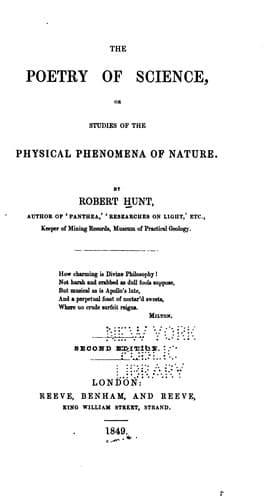
The Poetry of Science; or, Studies of the Physical Phenomena of NatureHunt, Robert
Philosophy
The Poetry of Science; or, Studies of the Physical Phenomena of Nature
Hunt, Robert
Physics; Science
An apparently dead grain is placed in the soil. If the temperature is a
few degrees above the freezing point, and the soil holds a due quantity
of water, the integument of the seed imbibes moisture and swells; the
tissue is softened, and the first effort of vital force begins. The
seed has now the power of decomposing water, the oxygen combines with
some of the carbon of the seed, and is expelled as carbonic acid.
Saussure’s experiments prove this. The air above the soil in which
a horse-bean was placed to germinate, gave, before the experiment,
nitrogen 210·26, and oxygen 56·29, and after germination, nitrogen
209·41, oxygen 44·38, and carbonic acid 11·27. This part of the process
is but little removed from the merely chemical changes which we have
already considered. We find the starch of the seed changed into gum and
sugar, which affords nutritive food for the developing embryo. The seed
now lengthens downwards by the radicle, and upwards by the cotyledons,
which, as they rise above the earth, acquire a green colour. Here the
first stage of vegetable life ends, the chemically exciting process is
at an end, and a new stimulus is required to continue in full activity
the vital powers. Carbonic acid is no longer given off.
The cotyledons, which are two opposite roundish leaves, act as the
lungs; by them carbonic acid taken from the atmosphere is absorbed
and carried by a circulating process, now in full activity, through
the young plant. The carbonic acid, a compound of carbon and oxygen,
is decomposed; it is deprived of its carbon, which is retained by the
plant, and oxygen is exhaled. The plant at this period is little more
than an arrangement of cellular tissue, a very slight development
of vascular and fibrous tissue appearing as a cylinder lying in the
centre of the sheath. At this point, however, we begin more distinctly
to trace the operations of the new power; the impulses of life are
strikingly evident.
The young root is now lengthening, and absorbing from the moisture in
the soil, which always contains some soluble salts, a portion of its
nutriment, which is impelled upwards by a force--probably capillary
attraction and endosmose action combined--to the point from which the
plumule springs. Capillary force raises the fluids through the tubes
in the stalk, and conveys them to the veins in the leaves, while
the endosmose force diffuses them through the vegetable tissues.
The plumule first ascends as a little twig, and, at the same time,
by exerting a more energetic action on the carbonic acid than the
cotyledons have done, the carbon retained by them being only so much
as is necessary to form chlorophylle, or the green colouring matter of
leaves, some wood is deposited in the centre of the radicle. From this
time the process of lignification goes on through all the fabric,--the
increase, and indeed the life, of the plant depending upon the
development of a true leaf from the plumule.
Public-domain text, read in full here on John Shaqi.
Reviews
Reviews
No reviews yet
Be the first to share your thoughts on this work.
Elsewhere in the archive
Join the Discussion
Join the discussion
Sign in to leave a comment or review.
Sign InorCreate an account