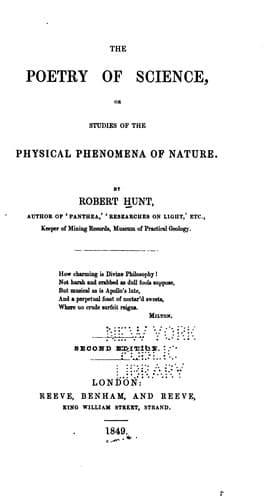
The Poetry of Science; or, Studies of the Physical Phenomena of NatureHunt, Robert
Philosophy
The Poetry of Science; or, Studies of the Physical Phenomena of Nature
Hunt, Robert
Physics; Science
“In consequence of a flower and its peduncle being a branch in a
particular state, the rudimentary or metamorphosed leaves which
constitute bracteæ, floral envelopes, and sexes, are subject to exactly
the same laws of arrangement as regularly-formed leaves.”[257]
The idea that the leaf is the principal organ of the plant, and that
from it all the other organs are probably developed, is worthy the
genius of the great German poet.
Every leaf, a mystery in itself, is an individual gifted with peculiar
powers; they congregate in families, and each one ministers to the
formation of the branch on
which it hangs, and to the main trunk of the tree of which it is a
member. The tree represents a world, every part exhibiting a mutual
dependence.
“The one red leaf, the last of its clan,
That dances as often as dance it can;
Hanging so light and hanging so high,
On the topmost twig that looks up at the sky,”
is influenced by, and influences, the lowest root which pierces
the humid soil. Like whispering voices, the trembling leaves sing
rejoicingly in the breeze and summer sunshine, and they tremble alike
with agony when the equinoctial gale rends them from the parent stalk.
The influences which pervade the whole, making up the sum of vital
force, are disturbed by every movement throughout the system; a wound
on a leaf is known to disturb the whole, and an injury inflicted on the
trunk interferes with the processes which are the functions of every
individual leaf.[258]
The consideration of the physical circumstances necessary to
germination and vegetable growth, brings us acquainted with many
remarkable facts. At a temperature below the freezing point, seeds will
not germinate; at the boiling point of water, a chemical change is
produced in the grain, and its power of germinating is destroyed. Heat,
therefore, is necessary to the development of the embryo, but its power
must only be exerted within certain prescribed limits: these limits are
only constant for the same class of seeds, they vary with almost every
plant. This is apparent to every one, in the different periods required
for germination by the seeds of dissimilar vegetables.
The seed is placed in the soil; shade is always--absolute darkness
sometimes--necessary for the success of the germinating process. We
have seen that the first operation of nature is purely a chemical one,
but this manifestation of affinity is due to an exertion of force,
which is directly dependent upon solar power. The seed is buried in the
soil, when the genial showers of spring, and the increasing temperature
of the earth, furnish the required conditions for this chemistry of
life, and the plant eventually springs into sunshine. Thus we obtain
evidence that even through some depth of soil the solar power, whatever
it may be, is efficient, and that under its excitement the first spring
of life, in the germ, is effected.
Public-domain text, read in full here on John Shaqi.
Reviews
Reviews
No reviews yet
Be the first to share your thoughts on this work.
Elsewhere in the archive
Join the Discussion
Join the discussion
Sign in to leave a comment or review.
Sign InorCreate an account