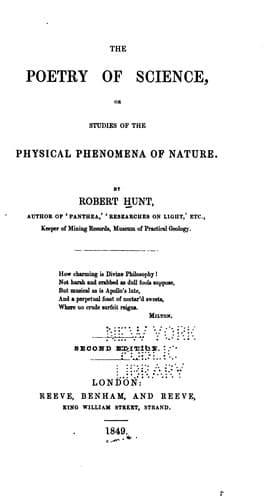
The Poetry of Science; or, Studies of the Physical Phenomena of NatureHunt, Robert
Philosophy
The Poetry of Science; or, Studies of the Physical Phenomena of Nature
Hunt, Robert
Physics; Science
The cotyledons and the plumule being formed, the plant undergoes a
remarkable change. The seed, like an animal, absorbed oxygen and
exhaled carbonic acid; the first leaves secrete carbon from carbonic
acid inspired, and send forth, as useless to the plant, an excess of
oxygen gas.
This power of decomposing carbonic acid is a vital function which
belongs to the leaves and bark. It has been stated, on the authority
of Liebig, that during the night the plant acts only as a mere bundle
of fibres,--that it allows of the circulation of carbonic acid and
its evaporation, unchanged. In his eagerness to support his chemical
hypothesis of respiration, the able chemist neglected to inquire
if this was absolutely correct. The healthy plant never ceases to
decompose carbonic acid during one moment of its existence; but during
the night, when the excitement of light is removed, and the plant
reposes, its vital powers are at their minimum of action, and a much
less quantity is decomposed than when a stimulating sun, by the action
of its rays, is compelling the exertion of every vital function.
During this process, we have another example of natural organic
chemistry. The four inorganic elements of which the vegetable kingdom
is composed--oxygen, hydrogen, nitrogen, and carbon--are absorbed as
air or moisture by the leaves and through the roots, and the great
phenomenon of vegetable life is the conversion of these to an organic
condition. Sugar and gum are constantly produced, and from these, by
combination with atmospheric nitrogen, a proteine compound is formed,
which is an essential element in the progress of development.[259]
Plants growing in the light are beautifully green, the intensity of
colouring increasing with the brilliancy of the light. Those which are
grown in the dark are etiolated, their tissues are weak and succulent,
their leaves of a pale yellow. It is, therefore, evident that the
formation of this chlorophylle--as the green colouring matter of leaves
is called--results from some action determined by the sun’s rays.
Chlorophylle is a carbonaceous compound formed in the leaves, serving,
it would appear, many purposes in the process of assimilation. In the
dark the plant still requires carbon for its further development,
and growing slowly, it removes it from the leaves, decomposing the
chlorophylle, and supports its weak existence by preying on parts of
its own structure, until at length, this being exhausted, it actually
perishes of starvation.
Plants always turn towards the light: the guiding power we know not,
but the evidence of some impulsive or attracting force is strong; and
the purpose for which they are constituted to obey it, is proved to be
the dependence of vegetable existence upon luminous power.
Public-domain text, read in full here on John Shaqi.
Reviews
Reviews
No reviews yet
Be the first to share your thoughts on this work.
Elsewhere in the archive
Join the Discussion
Join the discussion
Sign in to leave a comment or review.
Sign InorCreate an account