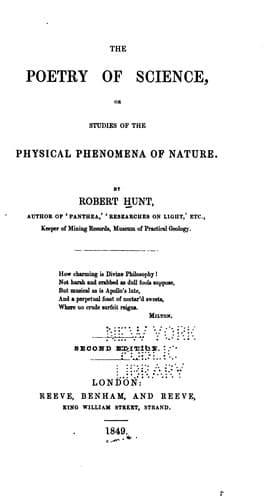
The Poetry of Science; or, Studies of the Physical Phenomena of NatureHunt, Robert
Philosophy
The Poetry of Science; or, Studies of the Physical Phenomena of Nature
Hunt, Robert
Physics; Science
Lowest in the scale of animals, and scarcely distinguishable from a
vegetable, we find the sponge, attached to and passing its life upon
a rock, exhibiting, indeed, less signs of feeling than many of the
vegetable tribes. The chemical differences between vegetables and
sponges are, however, very decided; and we find in the tissues of the
sponge a large quantity of nitrogen, a true animal element, which
exists, but in smaller quantities, in vegetables.
These creations, standing between vegetable and animal life, possess
the singular power of decomposing carbonic acid, as plants do; and the
water in which they live always contains an excess of free oxygen.
The polypes are a remarkably curious class. “Fixed in large arborescent
masses to the rocks of tropical seas, or in our own climate attached
to shells or other submarine substances, they throw but their
ramifications in a thousand beautiful and plant-like forms; or,
incrusting the rocks at the bottom of the ocean with calcareous earth,
separated from the water which bathes them, they silently build up
reefs and shoals, justly dreaded by the navigator; and sometimes giving
origin, as they rise to the surface of the sea, to islands, which
the lapse of ages clothes with luxuriant verdure, and peoples with
appropriate inhabitants.”[263]
Most of the polypes are fixed and stationary; but the hydra and some
others have the power of changing their positions, which they do in
search of the light of the sun. They do not appear to have organs of
sight requiring light; but still they delight in the solar influences.
The most extraordinary fact connected with the hydra is its being
multiplied by division. If an incision be made in the side of a hydra,
a young polype soon developes itself; and if one of these creatures be
divided, it quickly restores the lost portion of its structure. The
varieties of the polypes are exceedingly numerous, and many of them are
in the highest degree curious, and often very beautiful. The actiniæ,
like flowers, appear to grow from the rocks, unfolding their tentacula
to the light; and, in the excitement due to their eagerness for prey,
they exhibit a beautiful play of colours and most interesting forms.
Microscopic zoophytes of the most curious shapes are found,--all of
which attest, under examination, the perfection of all created things.
Infusoria and animalcula,--animals, many of them, appearing under the
microscope as little more than a transparent jelly,--must be recognized
as the most simple of the forms of life. They exist in all waters in
uncountable myriads; and, minute creatures as they are, it has been
demonstrated that many of the great limestone hills are composed
entirely of their remains.
Public-domain text, read in full here on John Shaqi.
Reviews
Reviews
No reviews yet
Be the first to share your thoughts on this work.
Elsewhere in the archive
Join the Discussion
Join the discussion
Sign in to leave a comment or review.
Sign InorCreate an account