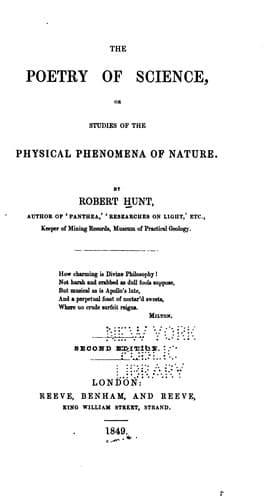
The Poetry of Science; or, Studies of the Physical Phenomena of NatureHunt, Robert
Philosophy
The Poetry of Science; or, Studies of the Physical Phenomena of Nature
Hunt, Robert
Physics; Science
The acalephæ, or the phosphorescent animals of the ocean, are no less
curious. From creatures of the most minute size, they extend to a
considerable magnitude, yet they appear to be little more than animated
masses of sea-water. If any one of these sea-jellies, or jelly-fishes
as they are often called (even the largest varieties of them), is cast
upon the shore, it is soon, by the influence of the sun, converted into
a mere fibre no thicker than a cobweb: an animal weighing seven or
eight pounds is very soon reduced to as many grains. There are numerous
kinds of these singular creatures, most of which are remarkable for
the powerful phosphorescent light they emit. The _beroes_ and the
_pulmonigrade_ shine with an intense white light many feet below the
surface, whilst the _Cestum Veneris_, or girdle of Venus, gliding
rapidly along, presents, on the edge of the wave, an undulating riband
of flame of considerable length. There can be no doubt that this arises
from the emission of phosphorescent matter of an unknown kind from the
bodies of these animals.
The microscope has made us familiar with the mysteries of a minute
creation which we should not otherwise have comprehended. These
creatures are found inhabiting the waters and the land, and they exist
in the intestinal structure of plants and animals, preying upon the
nutritive juices which pass through their systems. Although these
beings are so exceedingly small that even the most practised observer
cannot detect them with the naked eye, they are proved, by careful
examination under the microscope, to be in many cases elaborately
organized. Ehrenberg has discovered in them filamentary nerves and
nervous masses, and even vessels appropriated to the circulation
of fluids, showing that they belong really to a high condition of
existence.
Passing over many links in that curious chain which appears to bind
the animal kingdom into a complete whole, we come to the articulata of
Cuvier--the homogangliata of Owen.
All those creatures which we have been hitherto considering are too
imperfect in the construction of their simple organizations to maintain
a terrestrial existence; they are, therefore, confined to a watery
medium. In the articulata, we have evidences of higher attributes,
and indications of instincts developed in proportion to the increased
perfection of organization. Commencing with the annelidans, all of
which, except the earthworms, are inhabitants of the waters, we
proceed to the myriapoda, presenting a system intermediate in every
respect between that of worms and insects; we then find embraced in
the same order, the class insecta, which includes flies and beetles
of all kinds; and, as the fourth division of articulated beings, the
arachnidans or spiders; and, lastly, the marine tribe of crustaceans.
Public-domain text, read in full here on John Shaqi.
Reviews
Reviews
No reviews yet
Be the first to share your thoughts on this work.
Elsewhere in the archive
Join the Discussion
Join the discussion
Sign in to leave a comment or review.
Sign InorCreate an account