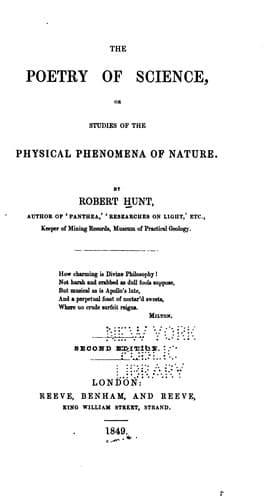
The Poetry of Science; or, Studies of the Physical Phenomena of NatureHunt, Robert
Philosophy
The Poetry of Science; or, Studies of the Physical Phenomena of Nature
Hunt, Robert
Physics; Science
Animals are dependent on several external agents for the support of
existence. The oxygen of the air is necessary for respiration. Animal
heat, as will be shown presently, is in a great measure dependent
upon it. The external heat is so regulated that animal existence is
comfortably supported. Electricity is without doubt an essential
element in the living processes; and, indeed, many physiologists have
been inclined to refer vital force to the development of electricity
by chemical action in the brain. This view has, however, no foundation
in experiment beyond that afforded by the appearance of electric
currents, when the brain is excited. This proves no more than that the
operations of mind develope physical power in the matter with which it
is mysteriously connected.
The phenomena of the Torpedo and Gymnotus we have already noticed,[264]
and there are other creatures which certainly possess the power of
secreting and discharging electricity. Galvani’s experiments, and
those of Aldini, appear to show--and the more delicate researches of
Matteucci have satisfactorily determined--that currents of electricity
are always circulating in the animal frame;--that positive electricity
is constantly passing from the interior to the exterior of a muscle.
Matteucci, by arranging a series of muscles, has formed an electric
pile of some energy.[265] These currents have been detected in man, in
pigeons, fowls, eels, and frogs.
In the human body it is evident a large quantity of electricity
exists in a state of equilibrium. Du Bois Raymond has shown that we
may by mere muscular motion give rise to electric currents which can
be measured by the galvanometer. This, however, may be said of every
substance. It is perhaps more easily disturbed in the human system;
indeed, the manifestation of sparks from the hair and other parts of
the body by friction is not uncommon. Every chemical action, it has
been already shown, gives rise to electrical manifestations; and the
animal body is a laboratory, beautifully fitted with apparatus, in
which nearly every chemical process is going on. It has been proved
that acid and alkaline principles are constantly acting upon each
other through the tissues of the animal frame; and we have the curious
phenomena of endosmose and exosmose in constant effort, and catalysis
or _surface force_, operating in a mysterious manner.[266]
With the refined physiological questions connected with the phenomena
of sensation we cannot deal, nor will any argument be adduced for or
against the hypothesis which would refer these phenomena to some
extraordinary development of electric force in the brain. The entire
subject appears to stand beyond the true limits of science, and every
attempt to pass it is invariably found to lead to a confused mysticism,
in which the real and the ideal are strangely confounded. Science stops
short of the phenomena of vital action.
Public-domain text, read in full here on John Shaqi.
Reviews
Reviews
No reviews yet
Be the first to share your thoughts on this work.
Elsewhere in the archive
Join the Discussion
Join the discussion
Sign in to leave a comment or review.
Sign InorCreate an account