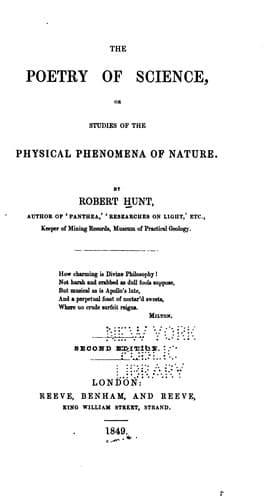
The Poetry of Science; or, Studies of the Physical Phenomena of NatureHunt, Robert
Philosophy
The Poetry of Science; or, Studies of the Physical Phenomena of Nature
Hunt, Robert
Physics; Science
As we ascend the scale of animal life we find a more perfectly
developed nervous system; and the relative size of the brain, compared
with that of the brute, is found progressively to increase, until it
arrives at the utmost perfection in man. On the system of nerves
depends sensation, and there can be no doubt that the more exalted the
order of intelligence displayed, the more exquisitely delicate is the
nervous system. Thus, in this world, refined genius must necessarily be
attended with a condition of sensibility which, too frequently, to the
possessor is a state of real disease.
It must be evident to every reader that but very few of the striking
features of animal life have been mentioned in the rapid survey which
has been taken of the progress of animal organization. The subject
is so extensive that it would be quite impossible to embrace it
within any reasonable limits; and it furnishes matter so curious and
so instructive, that, having once entered on it, it would have been
difficult to have made any selection, and we must have devoted a volume
to the æsthetics of natural science. Passing it by, therefore, with the
mere outline which has been given, we must proceed to consider some of
the conditions of vitality.
Bell has proved that one set of nerves is employed in conveying
sensation to the brain, and another set in transferring the desires of
the will to the muscles. By the separation of a main branch of one of
the nerves of sensation, although all the operations of life will still
proceed, the organ to which that nerve goes is dead to its particular
sense. In like manner, if one of the nerves of volition is divided,
the member will not obey the inclination of the brain. It is evident,
therefore, although many of the great phenomena of vital force are
dependent on the nervous system, and the paralysis of a member ensues
upon the separation or the disease of a nerve, that the nerves are but
the channels through which certain influences are carried. The _vis
vitæ_ or vital principle--for we are compelled by the imperfection of
our knowledge to associate under this one term the ultimate causes of
many of the phenomena of life--is a power which, although constantly
employed, has the capability of continually renewing itself by
some inexplicable connection existing between it and many external
influences. We know that certain conditions are necessary to the health
of animals. Diseased digestion, or any interruption in the circulation
of the blood, destroys the vital force, and death ensues. The processes
of digestion and of the circulation are perfectly understood, yet we
are no nearer the great secret of the living principle.
Public-domain text, read in full here on John Shaqi.
Reviews
Reviews
No reviews yet
Be the first to share your thoughts on this work.
Elsewhere in the archive
Join the Discussion
Join the discussion
Sign in to leave a comment or review.
Sign InorCreate an account