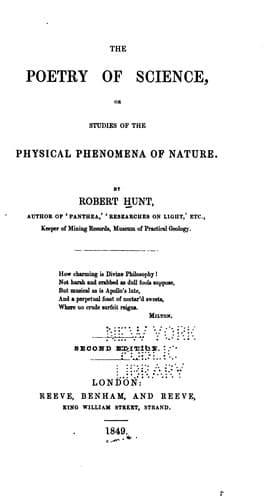
The Poetry of Science; or, Studies of the Physical Phenomena of Nature — John Shaqi
The Poetry of Science; or, Studies of the Physical Phenomena of NatureHunt, Robert
Philosophy
The Poetry of Science; or, Studies of the Physical Phenomena of Nature
Hunt, Robert
Physics; Science
[20] Delambre dates the commencement of modern astronomical observation
in its most perfect form from Maskelyne, who was the first who gave
what is now called a standard catalogue (A.D. 1790) of stars; that
is, a number of stars observed with such frequency and accuracy, that
their places serve as standard points of the heavens. His suggestion
of the _Nautical Almanack_, and his superintendence of it to the end
of his life, from its first publication in 1767, are mentioned in the
_Almanack_ (vol. i. p. 364); his _Schehallion Experiment on Attraction_
in vol. iii. p. 69; and the character of his _Greenwich Observations in
Greenwich Observatory_ in vol. ii. p. 442.
[21] _Experiments to determine the Density of the Earth._ By Henry
Cavendish, Esq., F.R.S. and F.A.S.--Philosophical Transactions, 1798.
[22] Adams: _An Explanation of the observed irregularities in the
motion of Uranus, on the hypothesis of disturbance caused by a more
distant Planet_.--Appendix to Nautical Almanack for 1851.
[23] Le Verrier: _Premier Mémoire sur la théorie d’Uranus_, Comptes
Rendus, vol. xxi.; _Sur la planête qui produit les anomalies observées
dans le mouvement d’Uranus_.--_Ib._ vol. xxiii.
[24] The experiment alluded to is one of a series by M. Plateau, who
thus describes his arrangement of the fluid:--“We begin by making a
mixture of alcohol and distilled water, containing a certain excess
of alcohol, so that when submitted to the trial of the test tube
it lets the small sphere of oil fall to the bottom rather rapidly.
When this point is obtained, the whole is thrown upon filters, care
being taken to cover the funnels containing these last with plates
of glass; this precaution is taken in order to prevent, as much as
possible, the evaporation of the alcohol. The alcoholic liquor passes
the first through the filters, ordinarily carrying with it a certain
number of very minute spherules of oil When the greater part has thus
passed, the spherules become more numerous; what still remains in the
first filters, namely, the oil and a residue of alcoholic liquor, is
then thrown into a single filter placed on a new flask. This last
filtration takes place much more slowly than the first, on account of
the viscosity of the oil; it is considerably accelerated by renewing
the filter once or twice during the operation. If the funnel has been
covered with sufficient care, the oil will collect into a single mass
at the bottom of the flask under a layer of alcoholic liquor.”--_On the
Phenomena presented by a free Liquid Mass withdrawn from the action of
Gravity._ By Professor Plateau, of the University of Ghent. Translated
from the _Memoirs of the Royal Academy of Brussels_, vol. xvi.; in the
_Scientific Memoirs_, vol. iv. part 13.
CHAPTER IV.
MOLECULAR FORCES.
Public-domain text, read in full here on John Shaqi.
Reviews
Reviews
No reviews yet
Be the first to share your thoughts on this work.
Join the Discussion
Join the discussion
Sign in to leave a comment or review.
Sign InorCreate an account