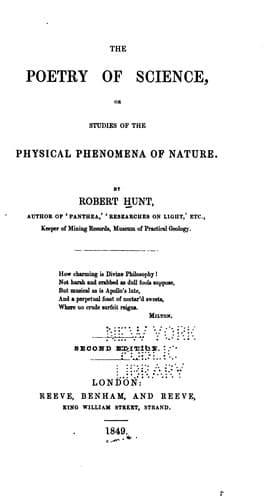
The Poetry of Science; or, Studies of the Physical Phenomena of NatureHunt, Robert
Philosophy
The Poetry of Science; or, Studies of the Physical Phenomena of Nature
Hunt, Robert
Physics; Science
We also find compounds which have two distinct systems of
crystallisation. This property, Dimorphism, is very strikingly shown
in carbonate of lime, which occurs in rhombohedrons, in calc spar, and
in rhombic prisms in arragonite. The molecular arrangements here are
not, however, of equal stability, and one form is evidently forced upon
the other, and is abandoned by it on the slightest disturbance. When a
prism of arragonite is heated it breaks up into the rhombs of common
calc spar, at a temperature far below that at which the carbonate of
lime is decomposed; but no alteration of temperature can convert calc
spar into arragonite.
Crystals are found in the most microscopic character, and of an
exceedingly large size. A crystal of quartz at Milan is three feet and
a quarter long, and five feet and a half in circumference, and its
weight is 870 pounds. Beryls have been found in New Hampshire measuring
four feet in length.[38]
In the dark recesses of the earth, where the influences which produce
organisation and life cease to act, a creative spirit still pursues its
never-ending task of giving form to matter.
The science of crystallogeny,[39] embracing the theoretical and
practical question of the causes producing these geometric forms,
has in various ways attempted to explain the laws according to which
molecules arrange themselves on molecules in perfect order, giving rise
to a rigidly correct system of architecture. But it cannot be said that
any theory yet propounded is sufficiently exact to embrace the whole
of the known phenomena, and the questions,--What is crystallogenic
attraction, and what is the physical nature of the ultimate particles
of matter,--are still open for the inquiries of that genius which
delights in wrestling with the secrets of nature.
The great Epicurus speculated on the “plastic nature” of atoms, and
attributed to this _nature_ the power they possess of arranging
themselves into symmetric forms. Modern philosophers satisfy themselves
with attraction, and, reasoning from analogy, imagine that each atom
has a polar system.
Public-domain text, read in full here on John Shaqi.
Reviews
Reviews
No reviews yet
Be the first to share your thoughts on this work.
Elsewhere in the archive
Join the Discussion
Join the discussion
Sign in to leave a comment or review.
Sign InorCreate an account