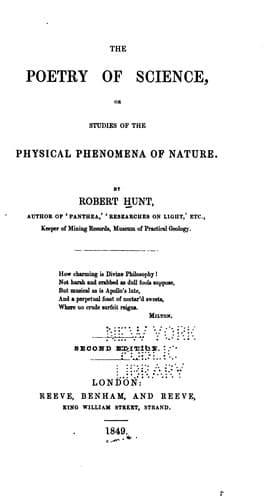
The Poetry of Science; or, Studies of the Physical Phenomena of NatureHunt, Robert
Philosophy
The Poetry of Science; or, Studies of the Physical Phenomena of Nature
Hunt, Robert
Physics; Science
Experience has proved that the conditions of the sun’s rays are not
always the same; and there are few persons who have not observed that
a more than usual scorching influence prevails under some atmospheric
circumstances. This is also evidenced in the effects produced on the
foliage of trees, which, though often attributed to electricity, is
evidently due to heat. An examination of the solar radiations, as
exhibited in the prismatic spectrum, has proved the existence of a
class of heat rays, which manifest themselves by a very peculiar
deoxidizing power quite independent of their caloric properties,
to which the name of _parathermic rays_ has been given.[48] We are
protected from the severe effects of these rays by the ordinary state
of the medium through which the solar heat passes. Our atmosphere is a
mixture of gases and aqueous vapour; and it has been found, as already
stated, that even a thin film of water, however transparent, prevents
the passage of many calorific radiations, and the rays retarded are,
for the most part, of that class which have this peculiar scorching
power. The air is, in this way, the great equaliser of the solar
heat, rendering the earth agreeable to all animals, who, but for this
peculiar absorbent medium, would have to endure, even in our temperate
clime, the burning rays of a more than African sun.
The surface of the earth during the sunshine--and, though in a less
degree, even when the sun is obscured by clouds--is constantly
receiving heat; but the rate of its absorption varies. Benjamin
Franklin showed, by a set of simple but most conclusive experiments,
that a piece of black cloth was warmed much sooner than cloth of a
lighter colour;[49] and we know, from observations of a similar class,
that the bare brown soil receives heat more readily than the bright
green grassy carpet of the earth. Consequently, during the winter
season, relatively to the quantity poured from its source, more heat
penetrates the uncovered soil, than during the spring or summer.
There is a constant tendency to an equilibrium; and, during the night,
the surface is robbed of more heat, by the colder air, than by day; as,
when the earth is not receiving heat, it is constantly radiating it
back into space. Even in these processes of convection and radiation, a
similar law prevails to that which is discovered in examining into the
rate of calorific absorption.
Public-domain text, read in full here on John Shaqi.
Reviews
Reviews
No reviews yet
Be the first to share your thoughts on this work.
Elsewhere in the archive
Join the Discussion
Join the discussion
Sign in to leave a comment or review.
Sign InorCreate an account