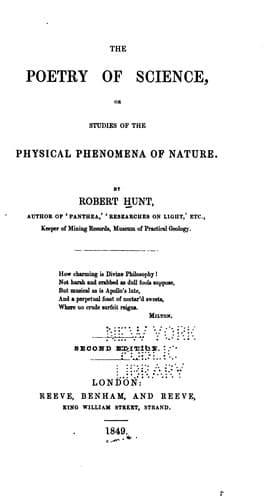
The Poetry of Science; or, Studies of the Physical Phenomena of NatureHunt, Robert
Philosophy
The Poetry of Science; or, Studies of the Physical Phenomena of Nature
Hunt, Robert
Physics; Science
Indeed, if we examine the most ancient of histories, we find one great
fact at the base of all their philosophies. Moses connects darkness
with a void and formless earth, and light with the creation of harmony
and life. Menis sings of a fearful world by “many formed darkness
encircled,” and links the idea of a “life-breathing divinity” with the
awakening of light upon created things. The Egyptian Isis, the Grecian
Apollo, who,
The Lord of boundless light
Ascending calm o’er the empyrean sails,
And with ten-thousand beams his awful beauty veils,
the fire-worshipper of the Persian hills and the sun-god of the
Peruvian mountains, exhibit, through time and space, the full
consciousness of man to the influences of solar light and heat upon the
organic creations of which he is himself the chief exemplar.
The investigations of modern philosophers have extended these
influences to the inorganic masses which constitute the Planet
EARTH:--and we now know that the physical forces, ever active in
determining the chemical condition and the electrical relations of
matter, are directly influenced by the solar radiations.
Few things within the range of our inquiry are more striking than
the phenomena of calorific radiation and absorption. They display so
perfectly the most refined system of order, and exhibit so strikingly
the admirable adaptation of every formation to its particular
conditions, and for its part in the great economy of being, that they
claim most strongly the study of all who would seek to discover a
poetry in the inferences of science.
Owing to the nature of our atmosphere, we are protected from the
influence of the full flood of solar heat. The absorption of caloric by
the air has been calculated at about one-fifth of the whole in passing
through a column of 6,000 feet. This estimate is, of course, made near
the earth’s surface; but we are enabled, knowing the increasing rarity
of the upper regions of our gaseous envelope in which the absorption
is constantly diminishing, to prove, that about one-third of the solar
heat is lost by vertical transmission through the whole extent of our
atmosphere.[47]
Public-domain text, read in full here on John Shaqi.
Reviews
Reviews
No reviews yet
Be the first to share your thoughts on this work.
Elsewhere in the archive
Join the Discussion
Join the discussion
Sign in to leave a comment or review.
Sign InorCreate an account