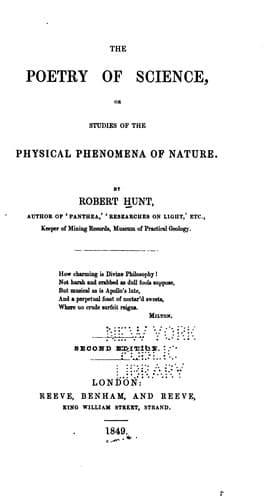
The Poetry of Science; or, Studies of the Physical Phenomena of NatureHunt, Robert
Philosophy
The Poetry of Science; or, Studies of the Physical Phenomena of Nature
Hunt, Robert
Physics; Science
The autumnal equinox has arrived, with its equal day and night, as in
the spring, but now the whole northern hemisphere is opposite the sun;
hence, according to the laws already explained, we see the causes of
the increased heat of the autumnal season.
The winter solstice has come, with its long night and shortened day.
The time during which radiation is going on is nearly twice that in
which absorption takes place, and the earth is in her worst position
for receiving heat, as that half which has the largest surface of water
is towards the sun.
These are the causes which lead to the variations of the seasons, and
through these we learn why we are colder when near the sun than when at
a considerably greater distance.
An analysis of the spectrum shows us that there are some changes
regularly taking place in the state of the solar beam, which cannot
be referred to the mere alteration of position. It may be inferred,
from facts by long-continued observations, that the three classes of
phenomena--light, heat, and chemical power, distinguished by the term
Actinism--which we detect in the sun’s rays, are constantly changing
their relative proportions. In spring, the chemical agency prevails; in
summer, the luminous principle is the most powerful; and in the autumn,
the calorific forces are in a state of the greatest activity.[52] The
importance of these variations, to the great economy of vegetable life,
will be shown when we come to examine the phenomena connected with
organisation.
Public-domain text, read in full here on John Shaqi.
Reviews
Reviews
No reviews yet
Be the first to share your thoughts on this work.
Elsewhere in the archive
Join the Discussion
Join the discussion
Sign in to leave a comment or review.
Sign InorCreate an account