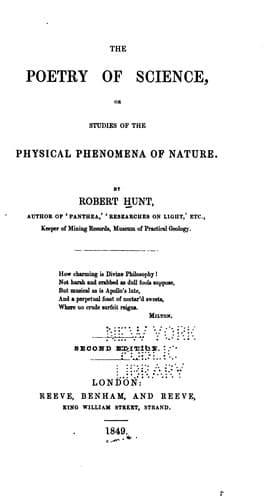
The Poetry of Science; or, Studies of the Physical Phenomena of NatureHunt, Robert
Philosophy
The Poetry of Science; or, Studies of the Physical Phenomena of Nature
Hunt, Robert
Physics; Science
A remarkable change takes place in the character of heat in being
reflected from material substances. In nature we often see this fact
curiously illustrated. Snow which lies near the trunks of trees or
wooden poles melts much quicker than that which is at a distance from
them, the sun shining equally on both--the liquefaction commencing on
the side facing the sun, and gradually extending. We see, therefore,
that the direct rays of solar heat produce less effect upon the snow
than those which are radiated from coloured surfaces. By numerous
experiments, it has been shown that these secondary radiations are
more abundantly absorbed by snow or white bodies than the direct solar
rays themselves. Here is one of the many very curious evidences, which
science lays open to us, of the intimate connection between the most
ethereal and the grosser forms of matter. Heat, by touching the earth,
becomes more earth-like. The subtile principle which, like the spirit
of superstition, has the power of passing, unfelt, through the crystal
mass, is robbed of its might by embracing the things of earth; and
although it still retains the evidences of its refined origin, its
movements are shackled as by a clog of clay, and its wings are heavy
with the dust of this rolling ball. It has, however, acquired new
properties, which fit it for the requirements of creation, and by which
its great tasks are facilitated. Matter and heat unite in a common
bond, and, harmoniously pursuing the necessities of some universal law,
the result is the extension of beautiful forms in every kingdom of
nature.
An easy experiment pleasingly illustrates this remarkable change. If a
blackened card is placed upon snow or ice in the sunshine, the frozen
mass underneath it will be gradually thawed, and the card sink into
it, while that by which it is surrounded, although exposed to the full
power of solar heat, is but little disturbed. If, however, we reflect
the sun’s rays from a metal surface, an exactly contrary result takes
place; the uncovered parts are the first to melt, and the blackened
card stands high above the surrounding portion.
The evidences of science all indicate the sun as the source, not only
of that heat which we receive directly through our atmosphere, but
even of that which has been stored by our planet, and which we can,
by several methods, develope. We have not to inquire if the earth was
ever an intensely heated sphere;--this concerns not our question; as
we should, even were this admitted, still have to speculate on the
origin--the primitive source of this caloric.
Before, however, we proceed to the examination of the phenomena of
terrestrial heat, a few of the great results of the laws of radiation
and convection claim our attention.
Public-domain text, read in full here on John Shaqi.
Reviews
Reviews
No reviews yet
Be the first to share your thoughts on this work.
Elsewhere in the archive
Join the Discussion
Join the discussion
Sign in to leave a comment or review.
Sign InorCreate an account