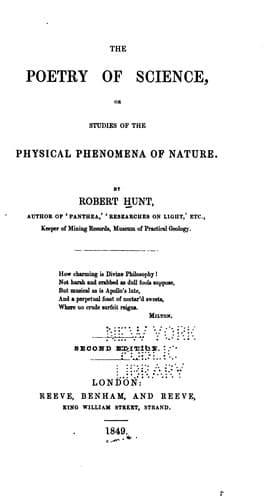
The Poetry of Science; or, Studies of the Physical Phenomena of NatureHunt, Robert
Philosophy
The Poetry of Science; or, Studies of the Physical Phenomena of Nature
Hunt, Robert
Physics; Science
There are many remarkable results dependent entirely on the colours
of bodies, which are not explicable upon the idea of difference in
mechanical arrangement. We know that different colours are regulated
by the powers which structures have of absorbing and reflecting light;
consequently a blue surface must have a different order of molecular
arrangement from a red one. But there are some physical peculiarities
which also influence heat radiation, quite independently of this
_surface_ condition. If we take pieces of red, black, green, and yellow
glass, and expose them when the dew is condensing, we shall find that
moisture will show itself first on the yellow, then on the green glass,
and last of all upon the black or red glasses. The same thing takes
place if we expose coloured fluids in white glass bottles or troughs,
in which case the surfaces are all alike. If against a sheet of
glass, upon which moisture has been slightly frozen, we place glasses
similarly coloured to those already described, it will be found that
the earliest heat-rays will so warm the red and the black glasses, that
the ice will be melted opposite to them, long before any change will be
seen upon the frozen film covered by the other colours.
The order in which heat permeates coloured media, it has already been
shown, very nearly agrees with their powers of radiation.
These most curious results have engaged the attention of Melloni,
to whose investigations we owe so much; and from the peculiar order
of radiations, which present phenomena of an analogous character to
those of the coloured rays of light, obtained by him from dissimilarly
coloured bodies, he has been led to imagine the existence of a
“heat-colouration.” That is, the heat-rays are supposed to possess
properties like luminous colour although invisible; and, consequently,
that a blue surface has a strong affinity for the blue heat-rays,
a red surface for the red ones, and so on through the scale. The
ingenuity of this hypothesis has procured it much attention; but now,
when the Newtonian hypothesis of the refrangibility of light is nearly
overturned, we must not, upon mere analogy, rush to the conclusion
that the rays of heat have different orders of refrangibility, which
Melloni’s hypothesis requires.[58]
Can anything be more calculated to impress the mind with the
consciousness of the high perfection of natural phenomena, than the
fact, that the colour of a body should powerfully influence the
transmission of a principle which is diffused through all nature,
and also determine the rate with which it is to pass off from its
surface. Some recent experiments have brought us acquainted with other
facts connected with these heat-radiations, and the power of heat,
as influenced by the calorific rays, to produce molecular changes in
bodies, which bear most importantly on our subject.
Public-domain text, read in full here on John Shaqi.
Reviews
Reviews
No reviews yet
Be the first to share your thoughts on this work.
Elsewhere in the archive
Join the Discussion
Join the discussion
Sign in to leave a comment or review.
Sign InorCreate an account