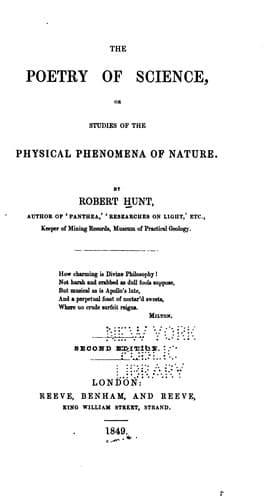
The Poetry of Science; or, Studies of the Physical Phenomena of NatureHunt, Robert
Philosophy
The Poetry of Science; or, Studies of the Physical Phenomena of Nature
Hunt, Robert
Physics; Science
If we throw upon a plate of polished metal a prismatic spectrum
(deprived, as nearly as possible, of its chemical power, by being
passed through a deep yellow solution--which possesses this property
in a very remarkable manner, as will be explained when we come to the
examination of the chemical action of the sun’s rays)--it will be
found, if we afterwards expose the plate to the action of vapour, very
slowly raised from mercury, that the space occupied by the red rays,
and those which lie without the spectrum below it, will condense the
vapour thickly, while the portion corresponding with the other rays
will be left untouched. This affords us evidence of the power of solar
heat to produce, very readily, a change in the molecular structure of
solid bodies. If we allow the sun’s rays to permeate coloured glasses,
and then fall upon a polished metallic surface, the result, on exposing
the plate to vapourisation, will be similar to that just described.
Under yellow and green glasses no vapour will be condensed; but on the
space on which the rays permeating a red glass, or even a blackened
one, fall, a very copious deposit of vapour will mark with distinctness
the spaces these glasses covered. More remarkable still, if these or
any other coloured bodies are placed in a box, and a polished metal
plate is suspended a few lines above them, the whole being kept _in
perfect darkness_ for a few hours, precisely the same effect takes
place as when the arrangement is exposed to the full rays of the sun.
Here we have evidence of the radiating heat of bodies, producing even
in darkness the same phenomena as the transmitted heat-rays of the sun.
We must, however, return to the examination of some of these and other
analogous influences under the head of actino-chemistry.
From these curious discoveries of inductive research we learn some high
truths. Associated with light--obeying many of the same laws--moving
in a similar manner--we receive a power which is essential to the
constitution of our planet. This power is often manifested in such
intimate combination with the luminous principle of the solar rays,
that it has been suspected to be but another form of the same agency.
While, however, we are enabled to show the phenomena of one without
producing those which distinguish the other, we are constrained to
regard heat as something dissimilar to light. It is true that we
appear to be tending towards some point of proof on this problem; but
we are not in a position to declare them to be forms of one common
power, or “particular solutions of one great physical equation.”[59]
In many instances it would certainly appear that one of these forces
was directly necessary to the production of the other; but we have also
numerous examples in which they do not stand in any such correlation.
Public-domain text, read in full here on John Shaqi.
Reviews
Reviews
No reviews yet
Be the first to share your thoughts on this work.
Elsewhere in the archive
Join the Discussion
Join the discussion
Sign in to leave a comment or review.
Sign InorCreate an account