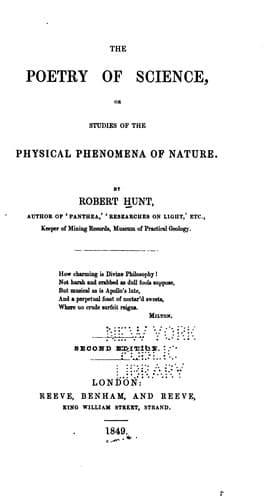
The Poetry of Science; or, Studies of the Physical Phenomena of NatureHunt, Robert
Philosophy
The Poetry of Science; or, Studies of the Physical Phenomena of Nature
Hunt, Robert
Physics; Science
Not only do dissimilar bodies radiate heat in different degrees, but
they conduct it also with constantly varying rates. Heat passes along
silver or copper with readiness, compared to its progress through
platinum. It is conducted by glass but slowly, and still more slowly
by wood and charcoal. We receive some important intimations of the
molecular structure of matter, from those experiments which prove that
heat is conducted more readily along some lines than others. In some
planes, wood and other substances are better conductors than in others.
The metallic oxides or earths are bad conductors of heat, by which
provision the caloric absorbed by the sun’s rays is not carried away
from the surface of this planet so rapidly as it would have been had
it been of metal, but is retained in the superficial crust to produce
the due temperature for healthful germination and vegetable growth. The
wool and hair of animals are still inferior conductors, and thus, under
changes of climate and of seasons, the beasts of the field are secured
against those violent transitions from heat to cold which would be
fatal to them. Hair is a better conductor than wool: hence, by nature’s
alchemy, hair changed into wool in the animals of some countries on the
approach of winter, and feathers into down.
It is therefore evident that the rate at which solar heat is conducted
into the crust of the earth must alter with the condition of the
surface upon which it falls. The conducting power of all the rocks
which have been examined is found to vary in some degree.[60]
It follows, as a natural consequence of the position of the sun to
the earth, that the parts near the equator become more heated than
those remote from it. As this heat is conducted into the interior of
the mass, it has a tendency to move to the colder portions of it, and
thus the heat absorbed at the equator flows towards the poles, and
from these parts is carried off by the atmosphere, or radiated into
space. Owing to this, there is a certain depth beneath the surface of
our globe at which an equal temperature prevails, the depth increasing
as we travel north or south from the equator, and conforming to the
contour of the earth’s surface, the line sinking under the valleys and
rising under the hills.[61]
Public-domain text, read in full here on John Shaqi.
Reviews
Reviews
No reviews yet
Be the first to share your thoughts on this work.
Elsewhere in the archive
Join the Discussion
Join the discussion
Sign in to leave a comment or review.
Sign InorCreate an account