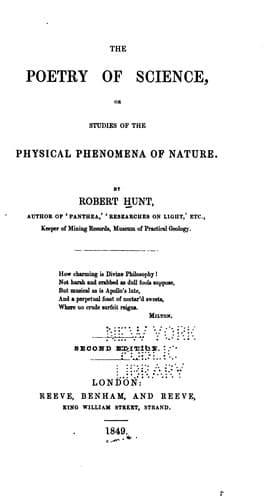
The Poetry of Science; or, Studies of the Physical Phenomena of NatureHunt, Robert
Philosophy
The Poetry of Science; or, Studies of the Physical Phenomena of Nature
Hunt, Robert
Physics; Science
We learn, from the scientific facts which we have been discussing, a
few of the secrets of natural magic. In their relations to heat, every
flower, which adds to the adornment of the wilds of nature or the
carefully-tended garden of the florist, possesses a power peculiar to
itself;
“Naiad-like lily of the vale,”
and,
“---- The pied wind-flowers, and the tulip tall,
And narcissi, the fairest among them all,”
are, by their different colours, prevented from ever having the same
temperatures under the same sunshine.
Every plant bears within itself the measure of the heat which is
necessary for its well-being, and is endued with functions which mutely
determine the relative amount of dew which shall wet its coloured
leaves. Some of the terrestrial phenomena of this remarkable principle
will still further illustrate the title of this volume.
To commence with the most familiar illustrations, let us consider the
consequences of change of temperature. However slight the additional
heat may be to which a body is subjected, it expands under its
influence; consequently, every atom which goes to form the mass of
the earth moves under the excitation, and the first heat ray of the
morning which touches the earth’s surface, sets up a vibration which
is continued as a tremor to its very centre. The differences between
the temperature of day and night are considerable; therefore all bodies
expand under the influence of the higher, and contract under that of
the lower temperature. During the day, any cloud obscuring the sun
produces, in every solid, fluid, or aëriform body, within the range
of solar influence, a check: the particles which had been expanding
under the force of heat suddenly contract. Thus there must of necessity
be, during the hours of sunshine, a tendency in all bodies to dilate,
and during the hours of night they must be resuming their original
conditions.
Public-domain text, read in full here on John Shaqi.
Reviews
Reviews
No reviews yet
Be the first to share your thoughts on this work.
Elsewhere in the archive
Join the Discussion
Join the discussion
Sign in to leave a comment or review.
Sign InorCreate an account