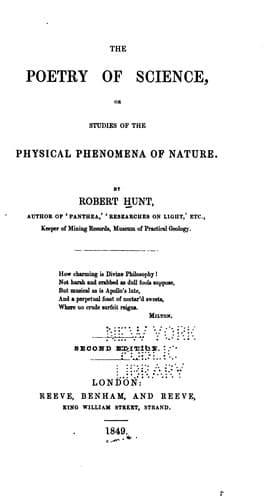
The Poetry of Science; or, Studies of the Physical Phenomena of NatureHunt, Robert
Philosophy
The Poetry of Science; or, Studies of the Physical Phenomena of Nature
Hunt, Robert
Physics; Science
The most general effect of heat is the expansion of matter; solids,
liquids, and airs, all expand under its influence. If a bar of metal
is exposed to calorific action, it increases in size, owing to its
particles being separated farther from each other: by continuing this
influence, after a certain time the cohesion of the mass is so reduced
that it melts, or becomes liquid, and, under the force of a still
higher temperature, this molten metal may be dissipated in vapour. It
would appear as if, under the agency of the heat applied to a body, its
atoms expanded, until at last, owing to the tenuity of the outer layer
or envelope of each atom, they were enabled to move freely over each
other, or to interpenetrate without difficulty. That heat does really
occasion a considerable disturbance in the corpuscular arrangement
of bodies, may be proved by a very interesting experiment. A bar of
heated metal is placed to cool, with one end supported upon a wedge
or a ring of a different metal the other resting on the ground. In
cooling, a distinct musical sound is given out, owing to the vibratory
action set up among the particles of matter moving as the temperature
declines.[68]
Heat is diffused through all bodies in nature, and, as we shall
presently see, may be developed in many different ways. We may,
therefore, infer, that in converting a sphere of ice into water, and
that again into steam, we have done nothing more than interpenetrate
the mass with a larger quantity of heat, by which its atoms are more
widely separated, and that thus its molecules become free to move
about each other. Hence, from a solid state, the water becomes fluid;
and then, if the expansive force is continued, an invisible vapour.
If these limits are passed by the powers of any greatly increased
thermic action, the natural consequence, it must be seen, will be the
separation of the atoms from each other, to such an extent that the
molecule is destroyed, and chemical decomposition takes place.
By the agency of the electricity of the voltaic battery, we are enabled
to produce the most intense heat with which we are acquainted, and by a
peculiarly ingenious arrangement Mr. Grove has succeeded in resolving
water by the mere action of heat into its constituent elements--oxygen
and hydrogen gases. That this decomposition is not due to the voltaic
current, but to the heat produced by it, was subsequently proved by
employing platina heated by the oxy-hydrogen flame.[69]
Public-domain text, read in full here on John Shaqi.
Reviews
Reviews
No reviews yet
Be the first to share your thoughts on this work.
Elsewhere in the archive
Join the Discussion
Join the discussion
Sign in to leave a comment or review.
Sign InorCreate an account