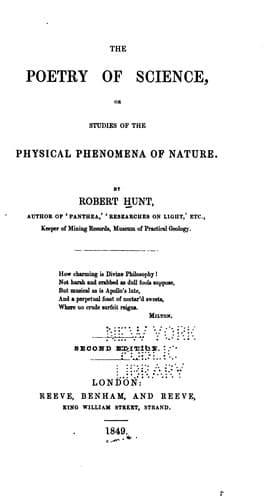
The Poetry of Science; or, Studies of the Physical Phenomena of NatureHunt, Robert
Philosophy
The Poetry of Science; or, Studies of the Physical Phenomena of Nature
Hunt, Robert
Physics; Science
This interesting question has been examined with great care by Dr.
Robinson of Armagh, who has shown that, as the temperature of water is
increased, the affinity of its elements is lessened, until at a certain
point it is eventually destroyed. This new and startling fact appears
scarcely consistent with our knowledge that a body heated so as to
be luminous has the power of causing the combination of the elements
of water with explosive violence.[70] But as this acute experimental
philosopher somewhat boldly but still most reasonably inquires: “Is
it not probable that, if not light, some other actinic power (like
that which accompanies light in the spectrum, and is revealed to us
by its chemical effects in the processes of photography) is evolved
by the heat, and, though invisible, determines, in conjunction with
the affinity, that atomic change which transforms the three volumes of
oxygen and hydrogen into two of steam?”[71]
This speculation explains, in a very satisfactory manner, some
results which were obtained by Count Rumford, in 1798. In a series of
experiments instituted for the purpose of examining “those chemical
properties of light which have been attributed to it,” he has shown
that many cases of chemical decomposition occur in perfect darkness,
under the influence of heat, which are precisely similar to those
produced by exposure to the sun’s rays.[72]
It must, however, be remembered, that both solar light and heat are
sometimes found in direct antagonism to actinic power, and that the
most decided chemical changes are produced by those rays in which
neither heat nor light can be detected. The most remarkable phenomena
of this class will be explained under the head of actinism.
One of the most curious relations which as yet have been discovered
between light and heat is, that, the temperature at which all bodies
become incandescent, excepting such as are phosphorescent, is uniform.
The point on the thermometer (Fahrenheit’s scale) when the eye by
perfect repose is enabled to detect the first luminous influence, may
probably be regarded as, or very near, 1000°. Daniel has fixed this
point at 980°, Wedgwood at 947°, and Draper at 977°.[73] Dr. Robinson
and Dr. Draper, by independent observations, have both arrived at the
conclusion, that the first gleam of light which appears from heated
platina is not red, but of a lavender gray, the same in character of
colour as that detected by Sir John Herschel among the most refrangible
rays of the solar spectrum.[74]
It must be admitted, that the question of the identity, or otherwise,
of light and radiant heat, is beset with difficulties. Many of their
phenomena are very similar--many of their modes of action are alike:
they are often found as allied agencies; but they as frequently exhibit
extreme diversity of action, and they may be separated from each other.
Public-domain text, read in full here on John Shaqi.
Reviews
Reviews
No reviews yet
Be the first to share your thoughts on this work.
Elsewhere in the archive
Join the Discussion
Join the discussion
Sign in to leave a comment or review.
Sign InorCreate an account