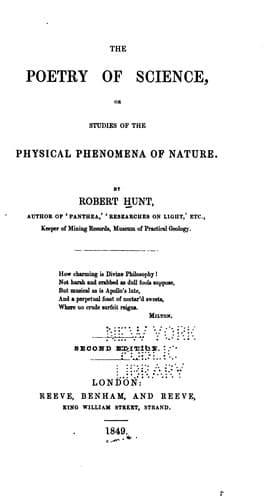
The Poetry of Science; or, Studies of the Physical Phenomena of NatureHunt, Robert
Philosophy
The Poetry of Science; or, Studies of the Physical Phenomena of Nature
Hunt, Robert
Physics; Science
A result similar to this was observed by Perkins, but its correctness
most unjustly doubted. Having made an iron shell containing water, and
carefully plugged up, white hot, it was found that the steam never
exerted sufficient force to burst the vessel, as it was expected
it would do. He caused a hole to be drilled into the bottom of the
white-hot shell, and he was surprised to find that no water flowed
through the orifice, until the iron was considerably cooled, when it
issued forth with violence in the form of steam. Here we have the
_Cagniard de la Tour state_ first induced, and the calorific repulsion
of the spheroidal state supervenes. If water is poured upon an iron
sieve, the wires of which are made red hot, it will not percolate;
but on cooling, it runs through rapidly. M. Boutigny, pursuing this
curious inquiry, has recently proved that the moisture upon the skin
is sufficient to protect it from disorganization, if the arm is plunged
into baths of melted metal. The resistance of the surfaces is so great,
that little elevation of temperature is experienced.[79] Professor
Plücker, of Bonn, has stated that by washing the arm with ether
previously to plunging it into melted metal, the sensation produced,
while in the molten mass, is that of freezing coldness.
We have now seen that heat at different degrees of intensity appears
to produce chemical composition--that it decomposes combined
elements--that it alters the conditions of bodies, and actually
maintains so powerfully a repellent force, that fluids cannot touch the
heated body. More than this, it exerts a most powerful antagonistic
influence over all chemical relations. If, to give one example,
the volatile element iodine is put into a glowing hot capsule, it
resolves itself immediately into a spheroid. Potash rapidly combines
with iodine; but if a piece of this alkali is thrown upon it in
the capsule, it also takes the spheroidal form, and both bodies
revolve independently of each other, their chemical affinities being
entirely suspended;--but allow the capsule to cool, and they combine
immediately. Science teaches us that a temperature so exalted as not to
burn organic bodies may be produced, and points to us this remarkable
fact, that the destructive limits of heat are measured between certain
degrees--beyond which a fire, by reason of its intensity, ceases to
develope heat. What is the radiant force into which this principle
changes?
The experiments of Cagniard de la Tour and of Boutigny (d’Evreux),
connect themselves, in a striking manner, with those of Mr. Grove and
Dr. Robinson; and they teach us that but a very slight alteration in
the proportions of the calorific principle given to this planet would
completely change the character of every material substance of which it
is composed, unless there was an alteration in the physical condition
of the elements themselves.
Public-domain text, read in full here on John Shaqi.
Reviews
Reviews
No reviews yet
Be the first to share your thoughts on this work.
Elsewhere in the archive
Join the Discussion
Join the discussion
Sign in to leave a comment or review.
Sign InorCreate an account