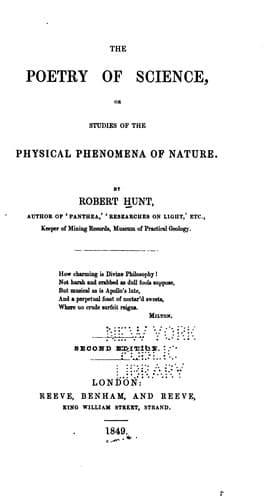
The Poetry of Science; or, Studies of the Physical Phenomena of NatureHunt, Robert
Philosophy
The Poetry of Science; or, Studies of the Physical Phenomena of Nature
Hunt, Robert
Physics; Science
There are a set of experiments by the Baron Cagniard de la Tour, which
appear to have a very important bearing on some conditions that may
be supposed to prevail in nature, particularly if we adopt the view of
a constantly increasing temperature towards the centre of our earth.
If water, alcohol, or ether, is put into a strong glass tube of small
bore, the ends hermetically sealed, and the whole exposed to a strong
heat, the fluid disappears, being converted into a transparent gas;
but, upon cooling, it is again condensed, without loss, into its
original fluid state.[77] In this experiment, fluid bodies have been
converted into elastic transparent gases with but small change of
volume, under the pressure of their own atmospheres. We can readily
conceive a similar result occurring upon a far more extensive scale.
In volcanic districts, at great depths, and consequently under the
pressure of the superincumbent mass, the siliceous rocks, or even
metals, may, from the action of intense heat, be brought into a fluid,
or even a gaseous condition, without any change of volume, since
the elastic force of heat is opposed by the rigid resistance of the
pressure of the surrounding rocks. Some beautiful experiments by Mr.
Hopkins, of Cambridge, have proved that the temperature necessary to
melt a body must be considerably elevated as the mechanical pressure to
which it is subjected is increased.
Directly connected with the results of Cagniard de la Tour are a yet
more remarkable set of phenomena, which have been investigated by
M. Boutigny,[78] and generally known as the “spheroidal condition”
of bodies. If water is projected upon very hot metal it instantly
assumes a spheroidal form--an internal motion of its particles may
be observed--it revolves with rapidity, and evaporates very slowly.
If a silver or platinum capsule, when brought to a bright red heat,
is filled with cold water, the whole mass assumes the spheroidal
state, the temperature of the fluid remaining considerably below the
boiling point, so long as the red heat is maintained. If we allow the
vessel to cool below redness in the dark, the water then bursts into
active ebullition, and is dissipated into vapour with almost explosive
violence. An equal quantity of water being projected into two similar
vessels, over the fire, one cold and the other red hot, it will be
found that the water in the cold vessel will boil and evaporate long
before that in the one which is red hot.
Another form of this experiment is exceedingly instructive. If a mass
of white hot metal is suddenly plunged into a vessel of cold water, the
incandescence is not quenched, the metal shines with a bright white
light, and the water is seen to circulate around, but at some distance
from the glowing mass, being actually repelled by calorific agency. At
length, when the metal cools, the water comes in contact with it, and
boils with energy.
Public-domain text, read in full here on John Shaqi.
Reviews
Reviews
No reviews yet
Be the first to share your thoughts on this work.
Elsewhere in the archive
Join the Discussion
Join the discussion
Sign in to leave a comment or review.
Sign InorCreate an account