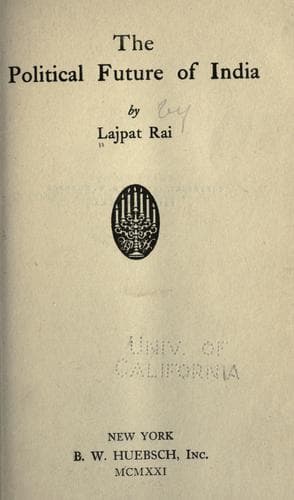
India -- History -- British occupation, 1765-1947; India -- Politics and government -- 1765-1947
Note: Images of the original pages are available through
Internet Archive. See
http://archive.org/details/politicalfutureo00lajpuoft
THE POLITICAL FUTURE OF INDIA
* * * * *
_OTHER BOOKS BY LAJPAT RAI_
YOUNG INDIA
_An Interpretation and a History of the Nationalist Movement
from Within_
Price $1.50 net
ENGLAND'S DEBT TO INDIA
_A Historical Narrative of Britain's Fiscal Policy in India_
Price $2.00 net
AN OPEN LETTER TO LLOYD GEORGE
Price 25 cents net
THE ARYA SAMAJ
_An Account of its Origins, Doctrines and Activities_
Price $1.75 net
OBTAINABLE FROM ALL BOOKSELLERS
* * * * *
THE POLITICAL FUTURE OF INDIA
by
LAJPAT RAI
[Illustration]
New York
B. W. Huebsch
MCMXIX
Copyright, 1919, by B. W. Huebsch
Printed in U.S.A.
TO MY FRIEND
COLONEL JOSIAH WEDGWOOD, M. P., D. S. O.
PREFACE
My book, _Young India_, was written during the first year of the war and
was finally revised and sent to the press before the war was two years
old. It concluded with the following observation:
"The Indians are a chivalrous people; they will not disturb
England as long as she is engaged with Germany. The struggle after
the war might, however, be even more bitter and sustained."
The events that have happened since have amply justified the above
conclusion. India not only refrained from disturbing England while she
was engaged in war with Germany, but actively helped in defeating
Germany and winning the war. She raised an army of over a million
combatants and supplied a large number of war workers, and made huge
contributions in money and materials. She denied herself the necessities
of life in order to feed and equip the armies in the field though within
the last months of the war, when scarcity and epidemic overtook her, she
lost six millions of her sons and daughters from one disease
alone--influenza. This was more than chivalry. This was self-effacement
in the interests of an Empire which, in the past, had treated her
children as helots. How much of this effort was voluntary and how much
of it was forced it is difficult to appraise. Great Britain, however,
has unequivocally accepted it as voluntary and has attributed it to
India's satisfaction with her rule. That India was not satisfied with
her rule she has spared no pains to impress upon the British people as
well as the rest of the world. Reading between the lines of the report
of the Secretary of State for India and the Viceroy has established the
fact of that dissatisfaction beyond the possibility of doubt, but if any
doubt still remained it has been dispelled by the writings and
utterances of her representative spokesman in India, in Great Britain
and abroad. The prince and the peasant, the landlord and the ryot, the
professor and the student, the politician and the layman--all have
spoken. They differ in their estimates of the "blessings" of British
Public-domain text, read in full here on John Shaqi.
Reviews
Reviews
No reviews yet
Be the first to share your thoughts on this work.
Join the Discussion
Join the discussion
Sign in to leave a comment or review.
Sign InorCreate an account