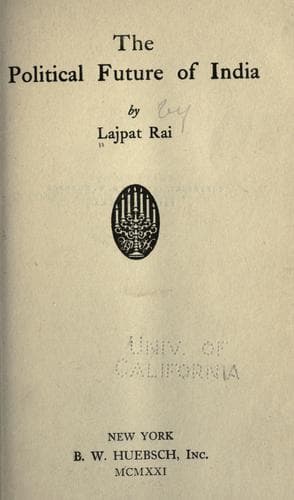
India -- History -- British occupation, 1765-1947; India -- Politics and government -- 1765-1947
There are numerous ways in which a subject nation feels the humiliation
and helplessness of her position, but none is so telling and so
effective as the subordination of her economic interests to those of the
dominant power. This is especially true in these days of free and easy
transportation, of quick journeys, and of scientific warfare. In any
struggle between nations, the victory eventually must rest with the one
in possession of the largest number of "silver bullets." It is true that
silver bullets alone will not do unless there are brains and bodies to
use them, but the latter without the former are helpless.
A nation may be the greatest producer of food; yet she may die of hunger
from lack of ability to keep her own produce for herself. Food obeys the
behest of the silver bullets. The law of self-preservation, therefore,
requires only that nations be free to regulate their own household,
subject to the condition that thereby they do not violate the rules of
humanity or trample upon the rights of any human being.
Mr. Montagu and Lord Chelmsford have, in parts of their Report, been
extremely candid. The value of their joint production lies in this
candidness. In no other part, perhaps, have they been so candid as in
the one dealing with "Industries and Tariff." In Paragraph 331 they
frankly admit the truth of the following observation of the late Mr.
Ranade on the economic effects of British rule in India:
"The political domination of one country by another attracts far
more attention than the more formidable, though more unfelt,
domination which the capital, enterprise and skill of one country
exercise over the trade and manufactures of another. This latter
domination has an insidious influence which paralyses the springs
of all the various activities which together make up the life of a
nation."
In the course of a letter addressed to the _Westminster Gazette_ in
1917, Lord Curzon said that "the fiscal policy of India during the last
thirty or forty years has been shaped far more in Manchester than in
Calcutta." This candid admission about "the subordination of Indian
fiscal policy to the Secretary of State and a House of Commons
powerfully affected by Lancashire influence," is the keynote of the
Indian demand for Home Rule. The authors of the Montagu-Chelmsford
Report say so quite frankly and fairly in Paragraphs 332 to 336 of their
report, from which we make the following extracts:
Public-domain text, read in full here on John Shaqi.
Reviews
Reviews
No reviews yet
Be the first to share your thoughts on this work.
Elsewhere in the archive
Join the Discussion
Join the discussion
Sign in to leave a comment or review.
Sign InorCreate an account