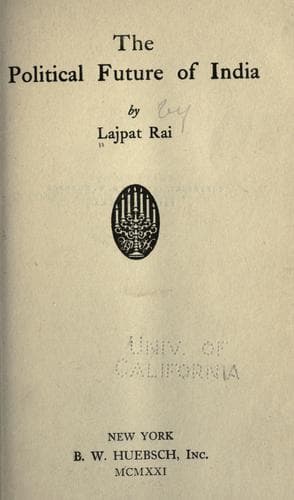
India -- History -- British occupation, 1765-1947; India -- Politics and government -- 1765-1947
We are not unaware that, according to the judgment of some thinkers,
amongst them Karl Marx, a country must pass through the capitalistic
mill, before the proletariat comes to its own. We do not believe in the
truth of this theory, but even if it be true we will not consciously
help in proving it to be true. The existing social order of Europe is
vicious and immoral. It is worm eaten. It has the germs of plague,
disease, death and destitution in it. It is in a state of decomposition.
It is based on injustice, tyranny, oppression and class rule. Certain
phases of it are inherent in our own system. Certain others we are
borrowing from our masters in order to make a complete mess. Wisdom and
foresight require that we be forewarned. What we want and what we need
is not the power to implant in full force and in full vigour the
_expiring_ European system, but power to keep out its development on
vicious lines, with opportunities of gradually and slowly undoing the
evil that has already been done.
The Government of India as at present constituted is a Government of
capitalists and landlords, of both England and India. Under the proposed
scheme the power of the former will be reduced and that of the latter
increased. The Indo-British Association does not like it, not because it
loves the masses of India for which it hypocritically and insincerely
professes solicitude, but because in their judgment it reduces the
profits of the British governing classes. We doubt if the scheme really
does affect even that. But if it does, it is good so far.
The ugly feature of the scheme is not its potentiality in transferring
the power into the hands of the Brahmins (the power of the Brahmin as
such, is gone for good), but in the possibility of its giving too much
power to the "profiteering" class, be they the landlords of Bengal and
Oudh, or the millionaires of Bombay. The scheme protects the European
merchants; it confers special privileges on the small European
Community; it provides special representation for the landlords, the
Chambers of Commerce, the Mohammedans and the Sikhs. What is left for
the general tax-paying public is precious little. The authors of the
scheme say that to withhold complete and immediate Home Rule is in the
interest of the general masses, the poor inarticulate ryot and the
workingman. We wish we could believe in it. We wish it were true.
Perhaps they mean it, but our past experience does not justify our
accepting it at its face value.
Public-domain text, read in full here on John Shaqi.
Reviews
Reviews
No reviews yet
Be the first to share your thoughts on this work.
Elsewhere in the archive
Join the Discussion
Join the discussion
Sign in to leave a comment or review.
Sign InorCreate an account