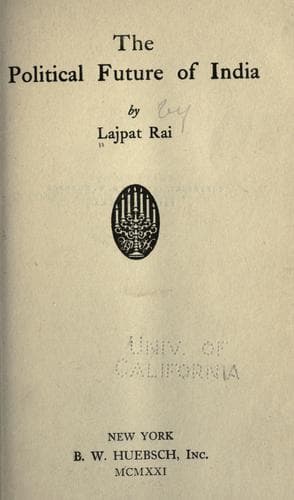
India -- History -- British occupation, 1765-1947; India -- Politics and government -- 1765-1947
There is, however, one thing we can do. We can ask them for proofs by
insisting on and agitating for the immediate legislative relief of the
ryot and the middle classes. We should adopt the aims of the British
Labour Party as our own, start educating our people on those lines and
formulate measures which will secure for them _real freedom_ and not the
counterfeit coin which passes for it. It will require years of education
and agitation but it has to be done, no matter whether we are ruled by
the British or by our own property holders. We are not opposed to Home
Rule. Nay, we press for it. In our judgment the objections urged against
giving it at once are flimsy and intangible. The chief obstacles are
such as have been created or perpetuated by the British themselves. The
caste does not prevent us from having _at least_ as much home rule as is
enjoyed by the people of Italy, Hungary, the Balkan States and some of
the South American Republics. But if we cannot have it at once and if
the British must retain the power of final decision in their hands, we
must insist upon something being immediately done not only to educate
the ryot but to give him economic relief. So long as the British
continue to refuse to do that we must hold them responsible for all the
misery that Indian humanity is suffering from.
We want political power in order to raise the intellectual and political
status of our masses. We do not want to bolster up classes. Our goal is
real liberty, equality and opportunity for all. We want to avoid, if
possible, the evils of the class struggle. We will pass through the mill
if we must, but we should like to try to avoid it. For that reason we
want freedom to legislate and freedom to determine our fiscal
arrangements. That is our main purpose in our demand for Home Rule.
XVIII
THE INTERNATIONAL ASPECT
Thus far we have discussed the Indian question from the internal or
national point of view. But it has an international aspect also. It is
said, and we hope that it is true, that the world is entering into an
era of new internationalism and that the old exclusive chauvinistic
nationalism is in its last gasps. This war was the greatest social
mix-up known to history. It has brought about the downfall of many
monarchs and the destruction of four empires. The armies of the
belligerents on both sides contained the greatest assortment of races
and nations, of religions and languages that were ever brought together
for mutual destruction. Primarily a fight between the European
Christians, it drew into its arena Hindus, Mohammedans, Buddhists,
Shintos, Jews and Negroes of Africa and America.
Public-domain text, read in full here on John Shaqi.
Reviews
Reviews
No reviews yet
Be the first to share your thoughts on this work.
Elsewhere in the archive
Join the Discussion
Join the discussion
Sign in to leave a comment or review.
Sign InorCreate an account