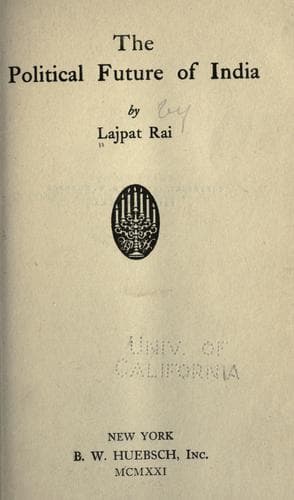
India -- History -- British occupation, 1765-1947; India -- Politics and government -- 1765-1947
"The first chapters of the report deal with India as an industrial
country, her present position, and her potentialities. They show how
little the march of modern industry has affected the great bulk of the
Indian population, which remains engrossed in agriculture, winning a
bare subsistence from the soil by antiquated methods of cultivation.
Such changes as have been wrought in rural areas are the effects of
economic rather than of industrial evolution. In certain centers the
progress of Western industrial methods is discernible; and a number of
these are described in order to present a picture of the conditions
under which industries are carried on, attention being drawn to the
shortage and to the general inefficiency of Indian labor and to the lack
of an indigenous supervising agency. Proposals are made for the better
exploitation of the forests and fisheries. In discussing the industrial
deficiencies of India, the report shows how unequal the industrial
development of our industries has been. Money has been invested in
commerce rather than industries, and only those industries have been
taken up which appeared to offer safe and easy profits. Previous to the
war, too ready reliance was placed on imports from overseas, and this
habit was fostered by the Government practice of purchasing stores in
England. India produces nearly all the raw materials necessary for the
requirements of a modern community; but is unable to manufacture many of
the articles and materials necessary alike in times of peace and war.
For instance, her great textile industries are dependent upon supplies
of imported machinery and would have to shut down if command of the seas
were lost. It is vital, therefore, for the Government to ensure the
establishment of those industries in India whose absence exposes us to
grave danger in event of war. The report advocates the introduction of
modern methods of agriculture and in particular of labor-saving devices.
Greater efficiency in cultivation, and in the preparation of produce for
the market would follow; labor now wastefully employed would be set free
for industries and the establishment of shops for the manufacture and
repair of machinery would lead to the growth of a huge engineering
industry."
The summarized statements will be made more clear by the following
extracts from Chapter I on rural India.
Public-domain text, read in full here on John Shaqi.
Reviews
Reviews
No reviews yet
Be the first to share your thoughts on this work.
Elsewhere in the archive
Join the Discussion
Join the discussion
Sign in to leave a comment or review.
Sign InorCreate an account