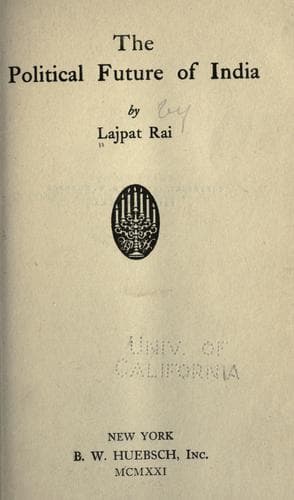
India -- History -- British occupation, 1765-1947; India -- Politics and government -- 1765-1947
India produces enormous quantities of leather on a relatively small
scale by modern processes; and the village tanner supplies the local
needs only, and with a very inferior material. To obtain the quantities
and standards of finished leather which the country requires, it will be
necessary to stimulate industries by the institution of technical
training and by the experimental work on a considerable scale.
"Large quantities of vegetable products are exported for the manufacture
of drugs, dyes and essential oils, which in many cases are re-imported
into India.
"The blanks in our industrial catalog are of a kind most surprising to
one familiar only with the European conditions. We have already alluded
generally to the basic deficiencies in our iron and steel industries
and have explained how, as a result, the many engineering shops in India
are mainly devoted to the repair or to the manufacture of, hitherto
mainly from imported materials, comparatively simple structures, such as
roofs, bridges, wagons and tanks. India can build a small marine engine
and turn out a locomotive provided certain essential parts are obtained
from abroad but _she has not a machine to make nails or screws, nor can
she manufacture some of the essential parts of electrical machinery_.[1]
"Electrical plant and equipment are still, therefore, imported, in spite
of the fact that incandescent lamps are used by the millions and
electric fans by the tens of thousands. India relies on foreign supplies
of steel springs and iron chains and for wire ropes, a vital necessity
of her mining industry. We have already pointed out the absence of any
manufacture of textile mill accessories. The same may be said of the
equipment of nearly all industrial concerns. The list of deficiencies
includes all kinds of machine tools, steam engines, boilers and gas and
oil engines, hydraulic presses and heavy cranes. Simple lathes, small
sugar mills, small pumps, and a variety of odds and ends are made in
some shops, but the basis of their manufacture and the limited scale of
production do not enable them to compete with imported goods of similar
character to the extent of excluding the latter. Agriculturists' and
planters' tools such as ploughs, _mamooties_, spades, shovels and
pickaxes are mainly imported as well as the hand tools of improved
character used in most cottage industries, including wood-working tools,
healds and reeds, shuttles and pickers. Bicycles, motor cycles and motor
cars cannot at present be made in India though the imports under these
heads were valued at Rs. 187 lakhs in 1913-1914. The manufacture of
common glass is carried on in various localities, and some works have
turned out ordinary domestic utensils and bottles of fair quality, but
no attempt has been made to produce plate or sheet glass or indeed any
of the harder kinds of commercial glass, while optical glass manufacture
has never even been mooted. The extent of our dependence on imported
Public-domain text, read in full here on John Shaqi.
Reviews
Reviews
No reviews yet
Be the first to share your thoughts on this work.
Elsewhere in the archive
Join the Discussion
Join the discussion
Sign in to leave a comment or review.
Sign InorCreate an account