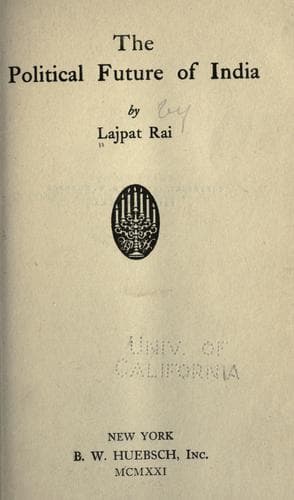
India -- History -- British occupation, 1765-1947; India -- Politics and government -- 1765-1947
"We have already referred to the dependence of India on outside sources
of sulphur and the necessity for insisting on the local smelting of her
sulphide ores. In the absence of any means for producing from purely
Indian sources sulphuric, nitric, and hydrochloric acids, and alkalis,
our manufactures, actual or prospective, of paper, drugs, matches, oils,
explosives, disinfectants, dyes and textiles are dependent upon imports
which under war conditions, might be cut off. Sources of raw materials
for heavy chemicals are deficient. The output of saltpeter could be
raised to 40,000 tons per annum and supplementary supplies of nitrates
could be produced, if necessary, from atmospheric nitrogen; but for this
again, cheap electric power is needed. Salt occurs in abundance and the
establishment of caustic soda manufacture, preferably by an electric
process, that would also yield chlorine, is a necessary part of our
chemical programme. There are available in the country, in fair
quantity, many other raw materials necessary for heavy chemical
manufacture, in addition to those referred to under other heads; among
them may be mentioned alum, salts, barytes, borax, gypsum, limestone,
magnesia, phosphates of lime and ochres. The installation of plants for
the recovery of by-products in coking has recently been undertaken, but
for the recovery of tar and ammonia only. The recovery of benzol and
related products has so far not been attempted nor has anything been
done to utilise the tar by re-distillation or other chemical treatment.
"Although India exported raw rubber valued in 1917-1918 at 162 lakhs,
rubber manufacture has not been started in the country and goods to the
value of 116 lakhs were imported in 1917-1918. This industry is one of
those that are essential in the national interest and should be
inaugurated, if necessary, by special measures.
"Though textile industries exist on a large scale, the range of goods
produced is still narrow, and we are dependent upon foreign sources for
nearly all of our miscellaneous textile requirements. In addition to
these, the ordinary demands of Indian consumers necessitate the import
of some Rs. 66 crores worth of cotton piece-goods, and interference with
this source of supply has caused serious hardship. Flax is not yet grown
in appreciable quantities and the indigenous species of so-called hemp,
though abundantly grown, are not at present used in any organized Indian
industry.
"Our ability to produce and to preserve many of our foodstuffs in
transportable forms or to provide receptacles for mineral or vegetable
oils depends upon the supply of tin plates which India at present
imports in the absence of local manufactures.
"Our few paper factories before the war stood on an uncertain basis and
we are still dependent upon foreign manufacture for most of the higher
qualities."
Public-domain text, read in full here on John Shaqi.
Reviews
Reviews
No reviews yet
Be the first to share your thoughts on this work.
Elsewhere in the archive
Join the Discussion
Join the discussion
Sign in to leave a comment or review.
Sign InorCreate an account