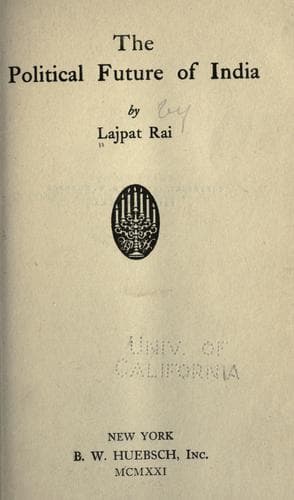
India -- History -- British occupation, 1765-1947; India -- Politics and government -- 1765-1947
Now therefore by virtue of the powers vested in me by martial law
I authorize any officer appointed by me for that purpose to enter
any college, public building, hostel, hotel, private or other
residence or building and remove such number of electric lights
and fans required for the purpose aforesaid,
And any attempt to obstruct such removal, or to hide, or to damage
or to impair the immediate efficiency of any such fans or lights,
will be summarily dealt with under martial law,
But nothing in this order shall authorize the removal of any fan
or light from a room usually inhabited by a woman.
These are only a few of the orders we have been able to obtain.
For weeks the Punjab was in a state of terror. Almost all of the
Native papers were either directly or indirectly suppressed or
terrorized into silence. Numerous persons were arrested and placed
for trial before military commissioners. Among them were a large
number of the most honored men in the province. Legal counsel from
outside the province was denied to them, and admission of
newspapermen into the province barred. In punishing the persons
found guilty the military commissioners have awarded sentences,
the parallel of which can only be found in the history of Czarism
in Russia. Flogging in the public was resorted to in more than one
place. In short, a complete reign of terror was established. So
great was the terrorism that the whole country was thrown into
such a paroxysm of rage, anger and despair as to make the people
forget the desire for a political constitution at this terrible
price.
Just as I am writing these lines I learn from the London _Times_ that
the reports of the two committees that were sent to India to inquire
into (_a_) questions connected with the franchise and (_b_) the division
of functions between the Government of India and local governments, and
between the official and the popular elements in the local governments,
have been published in Great Britain. In one of the Appendices is given
a rather brief and inadequate summary of the recommendations of these
committees published by the London _Times_. At this stage it is
impossible to make any comments except that the franchise is by no
means as broad as it could have been, the restriction of local residence
on candidates for the provincial Legislative Councils extremely
unreasonable, and the strength of the Provincial Councils very meagre.
The recommendations are unsatisfactory in other respects also, specially
the power granted to the Governor to dismiss ministers.
The question, however, is, "Will the Cabinet stand by these
recommendations or will they allow them to be whittled down?" Mr.
Montagu's bill, which is promised to be introduced in the House of
Commons early in June, will answer the question.
In conclusion, I have to tender my thanks to my friend Dr. J. T.
Sunderland for having read my proofs.
Public-domain text, read in full here on John Shaqi.
Reviews
Reviews
No reviews yet
Be the first to share your thoughts on this work.
Join the Discussion
Join the discussion
Sign in to leave a comment or review.
Sign InorCreate an account