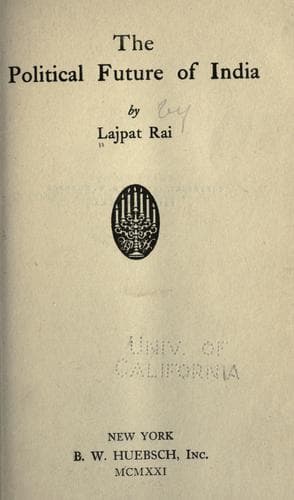
India -- History -- British occupation, 1765-1947; India -- Politics and government -- 1765-1947
Firstly, we wish to make clear what we understand by "democracy." There
is no desire to enter into an academic discussion of the subject nor to
burden this book with quotations from eminent thinkers and writers. In
our judgment, the best definition of democracy so far has been furnished
by Abraham Lincoln, viz., "the government of the people, by the people
and for the people," regardless of the process or processes by which
that government is constituted. One must, however, be clear minded as to
what is meant by "the people." Does the expression include all the
people that inhabit the particular territory to which the expression
applies, regardless of sex, creed, color and race, or does it not? If it
does, we are afraid there is little democracy even in Europe and America
today. Until recently half of the population was denied all political
power in the State by virtue of sex. Of the other half a substantial
part was denied that right by virtue of economic status or, to be more
accurate, by lack of economic status considered necessary for the
exercise of political power. Even now the Southern States of the United
States, Amendment XV to the American Constitution notwithstanding,
effectively bar the colored people from the exercise of the franchise
supposed to have been accorded to them by the amendment. In Europe,
religious and social bars still exist in the constitutions of the
different states. As Great Britain is supposed to be the most democratic
country in Europe, we cannot do better than take the history of the
growth of public franchise in that country as the best illustration of
the growth of democracy in the terms of President Lincoln's formula.
Public-domain text, read in full here on John Shaqi.
Reviews
Reviews
No reviews yet
Be the first to share your thoughts on this work.
Join the Discussion
Join the discussion
Sign in to leave a comment or review.
Sign InorCreate an account