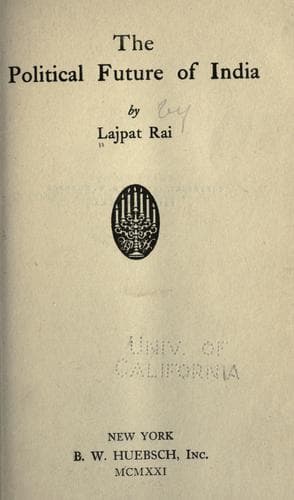
India -- History -- British occupation, 1765-1947; India -- Politics and government -- 1765-1947
(3) Even when kingship became an established institution the idea that
the King was only a servant of the people survived for a long time. His
"remuneration" was fixed at one-sixth of the produce. His subjects had
the right to depose him or to turn him out if he failed in his duty. The
authorities on these points are collected by Mr. Banerjea on pp. 72 and
73 of his book.
(4) Similarly many authorities are quoted by Mr. Banerjea on pp. 74 and
75 of his learned work showing that, according to Hindu ideals practised
in ancient times, the king was not above the law. He was not an
autocrat. He was as much bound by the law as his subjects. Laws were not
made by kings. "Legislation was not among the powers entrusted to a
king," says Mr. Banerjea. "There is no reference in early Vedic
literature to the exercise of legislative authority by the king, though
later it is an essential part of his duties," says Prof. Macdonell.[10]
(5) Assemblies and councils are quite frequently mentioned both in the
Rig and the Atharva Vedas. "The popular assembly was a regular
institution in the early years of the Buddhistic age (500 to 300 B.C.)"
Chanakya mentions that in the King's Council the decision of the
majority should prevail.[11] Sukraniti lays down elaborate rules of
procedure for the conduct of business in these assemblies. "The Council
was the chief administrative authority in the kingdom. The King was
supposed not to do anything without the consent of the Council."[12] In
_Kerala_ State, South India, during the first and second centuries of
the Christian Era, there were five assemblies one of which consisted of
"representatives of the people summoned from various parts of the
State."[13] "From the Ceylon inscriptions we learn that in that island
all measures were enacted by the King in Council, and all orders were
issued by and under the authority of the Council."
Public-domain text, read in full here on John Shaqi.
Reviews
Reviews
No reviews yet
Be the first to share your thoughts on this work.
Join the Discussion
Join the discussion
Sign in to leave a comment or review.
Sign InorCreate an account