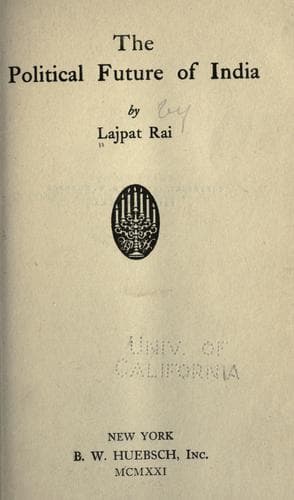
India -- History -- British occupation, 1765-1947; India -- Politics and government -- 1765-1947
On the sixteenth of January in the _Gazette of India_ was published a
draft of two bills that were proposed to be brought before the
Legislative Council of India (which has a standing majority of
Government officials). These bills were to give effect to the
recommendations of the committee presided over by Mr. Justice Rowlatt of
the High Court of England, for the prevention, detection and punishment
of sedition in India. Their introduction into the Legislative Council
was at once protested against by all classes of Indians with a unanimity
never before witnessed in the history of India. All sections of the
great Indian population from the Prince to the peasant, including all
races, religions, sects, castes, creeds and professions joined in the
protest. Hindus, Mohammedans, Indian Christians, Sikhs, Buddhists,
Parsees--all stood up, to a man, to oppose the measure. All the
political parties, Conservatives, Liberals, Moderates and Extremists
expressed themselves against it. The measure was opposed by all the
non-official Indian members of the Legislative Council. All methods of
agitation were resorted to in order to make the opinion of the country
known to the Government and to warn the latter against the danger of
defying the united will of the people. The press, the pulpit and the
platform all joined in denouncing the measures, meetings of protest were
held in all parts of the country and resolutions wired to the
Government. A few days before the final meeting at which these bills
were to be passed into law a number of prominent citizens, male and
female, pledged themselves to passive resistance in case the measures
were enacted. The passive resistance movement was inaugurated and led by
Mr. M. K. Gandhi, a man of saintly character, universally respected and
revered in India, the same who stood for the Government during the war
and rendered material help in recruiting soldiers, raising loans and
procuring other help for its prosecution. The following is the text of
the pledge that was signed by hundreds and thousands of Indians
belonging to all races and religions and hailing from all parts of the
continent:
"Being conscientiously of opinion that the bills known as the
Indian Criminal Law (Amendment) Bill No. 1 of 1919 and No. 2 of
1919 are unjust, subversive of the principle of liberty and
justice and destructive of the elementary rights of individuals on
which the safety of the community as a whole and the State itself
is based, we solemnly affirm that, in the event of these bills
becoming law, we shall refuse civilly to obey these laws and such
other laws as a committee to be hereafter appointed may think fit
and we further affirm that in this struggle we will faithfully
follow truth and refrain from violence of life, person or
property."
Public-domain text, read in full here on John Shaqi.
Reviews
Reviews
No reviews yet
Be the first to share your thoughts on this work.
Join the Discussion
Join the discussion
Sign in to leave a comment or review.
Sign InorCreate an account