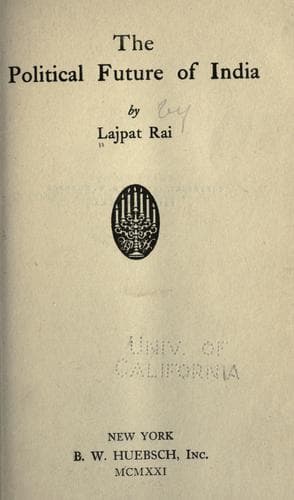
India -- History -- British occupation, 1765-1947; India -- Politics and government -- 1765-1947
The Brahmins of India have left a monumental record of their labors.
They produced great thinkers, writers, legislators, administrators and
organizers. In their own time they were as wise, energetic and
resourceful as any bureaucracy in the world has ever been or will ever
be. Yet the system of life they devised cut at the roots of national
vitality. It dried almost all the springs of corporate national life. It
reduced the bulk of the population to a position of complete
subservience to their will, of blind faith in their wisdom, of absolute
dependence on their initiative. It deprived the common people of all
opportunities of independent thought and independent action. It brought
about a kind of national atrophy. And this, in spite of the fact that
they began by imposing a rigorous code of self-denial on themselves and
their class. For themselves they wanted nothing but a life of poverty
and asceticism. Their economic interests were never in theory or in
practice in conflict with those of the rest of the body politic.
A Brahmin was forbidden to engage in trade or otherwise accumulate
wealth. His life was a life of strict self-abnegation. This cannot be
said of the Indian Civil Servant. He receives a handsome salary for his
services, expects and receives periodic promotion until he reaches a
position which, from an economic point of view, is not unenviable. After
retirement he is free to engage in trade and otherwise accumulate
wealth. But over and above this, what distinguishes an Indian Civil
Servant from an old Brahmin bureaucrat is the fact that in India he
represents a nation whose economic interest may not always be in harmony
with those of the people of India. He is thus supposed to be the
guardian of the interests of his countrymen, and is expected to further
them as much as he can without altogether endangering the safety of
British rule in India. Looked at from this angle, we have no hesitation
in saying that the work of the Indian Civil Service, too, has in its
way, been monumental. As a rule, they have proved capable
administrators, individually honest, hardworking and alert. They have
organized and tabulated India in a way, perhaps, never done before. But
after all has been said in their praise, it cannot be denied that they
have done India even more harm than the Brahmin oligarchy in its time,
did, by the support they lent to economic exploitation of the country by
men of their own race and religion. Now, in this latter respect, we
want to guard against being misunderstood. The Indian Civil Service has,
in the course of about a century, produced a fairly good number of men
who have honestly and fearlessly stood for the protection of Indian
interests against those of people of their own race and religion. In
doing so they have sometimes ruined their own prospects of promotion and
advancement. Whenever they failed in their self-imposed task, and more
often they failed than not, they failed because the authorities at the
Public-domain text, read in full here on John Shaqi.
Reviews
Reviews
No reviews yet
Be the first to share your thoughts on this work.
Elsewhere in the archive
Join the Discussion
Join the discussion
Sign in to leave a comment or review.
Sign InorCreate an account