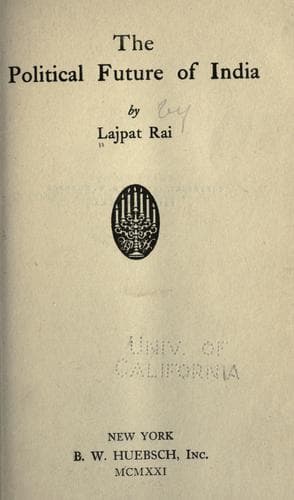
India -- History -- British occupation, 1765-1947; India -- Politics and government -- 1765-1947
As regards (_a_) we have already quoted the opinion of the eminent
authors of the report. The principle laid down in the announcement of
August 20, and the scheme proposed are supposed to do away with the
element of irresponsibility. It is obvious that with the introduction of
the principle of popular control into the Government, the power of
individual servants of the executive will not remain what it is now, or
has been in the past. Much that is vested in and done by the service
will be transferred to public bodies elected by popular vote. This will
naturally affect (_b_) and (_c_) also. We will here stop to quote again
from the Report:
"In the forefront of the announcement of August 20 the policy of
the increasing association of Indians in every branch of the
administration was definitely placed. It has not been necessary
for us, nor indeed would it have been possible, to go into this
large question in detail in the time available for our inquiry. We
have already seen that Lord Hardinge's Government was anxious to
increase the number of Indians in the public services, and that a
Royal Commission was appointed in 1912 to examine and report on
the existing limitations in the employment of Indians.... The
report was signed only a few months after the outbreak of war, and
its publication was deferred in the hope that the war would not be
prolonged. When written, it might have satisfied moderate Indian
opinion, but when published two years later it was criticised as
wholly disappointing. Our inquiry has since given us ample
opportunity of judging the importance which Indian opinion
attaches to this question. While we take account of this attitude,
a factor which carries more weight with us is that since the
report was signed an entirely new policy toward Indian government
has been adopted, which must be very largely dependent for success
on the extent to which it is found possible to introduce Indians
into every branch of the administration."
The authors of the Report then proceed to state the limitations of the
process, subject to the general remark that at the present moment there
are few Indians (we do not admit this) trained in public life, who can
replace the Europeans, and thus to alter the personnel of a service
must be a long and steady process. They admit that:
"If responsible government is to be established in India there
will be a far greater need than is even dreamt of at present for
persons to take part in public affairs in the legislative
assemblies and elsewhere; and for this reason the more Indians we
can employ in the public services the better. Moreover, it would
lessen the burden of Imperial responsibilities if a body of
capable Indian administrators could be produced. We regard it as
necessary, therefore, that recruitment of a largely increased
proportion of Indians should be begun at once."
Public-domain text, read in full here on John Shaqi.
Reviews
Reviews
No reviews yet
Be the first to share your thoughts on this work.
Elsewhere in the archive
Join the Discussion
Join the discussion
Sign in to leave a comment or review.
Sign InorCreate an account