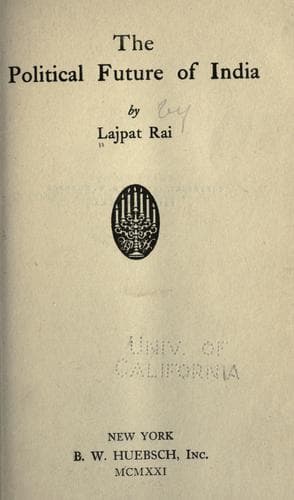
India -- History -- British occupation, 1765-1947; India -- Politics and government -- 1765-1947
"267. The main fault for the clogging of the machine does not, we
think, lie altogether with its highly trained engineers. What is
chiefly wanted is some change of system in the directions of
simplicity and speed. _How does it happen that announcements are
made that arouse expectations only to defeat them?_ We know that
it is not from any intention of deluding the public. We suggest
that it is because the wheels move too slowly for the times; the
need for change is realized, but because an examination of details
would take too long, promises are made in general terms, which on
examination it becomes necessary so to qualify with reservations
as to disappoint anticipations, and even to lead to charges of
breach of faith. We suspect that a root-cause of some political
discontent lies in such delays. Now, so far as the provinces are
concerned, we believe that our proposals _for freeing them to a
great extent from the control of the Government of India and the
Secretary of State will improve matters. But the Government of
India are in the worst case_." [The italics are ours.]
These observations raise an apprehension in our mind that it is proposed
to add to the strength of the services under the Government of India.
We, for ourselves, do not see how it can be otherwise. With the steady
admission of the popular element into the Government of India the
activities of the latter are likely to increase rather than diminish;
the secretarial work of the different departments will expand rather
than contract. The question of questions is how to meet the increased
cost.
The remedy is the same as was suggested many years ago by Sir William
Hunter, the official historian of India. He said:
"If we are to give a really efficient administration to India, many
services must be paid for at lower rates even at present. For those
rates are regulated in the higher branches of the administration by the
cost of officers brought from England. You cannot work with imported
labor as cheaply as you can with native labor, and I regard the more
extended employment of the natives, not only as an act of justice, but
as a financial necessity. If we are to govern the Indian people
efficiently and cheaply, we must govern them by means of themselves, and
pay for the administration at the market rates for native labor."
Public-domain text, read in full here on John Shaqi.
Reviews
Reviews
No reviews yet
Be the first to share your thoughts on this work.
Elsewhere in the archive
Join the Discussion
Join the discussion
Sign in to leave a comment or review.
Sign InorCreate an account