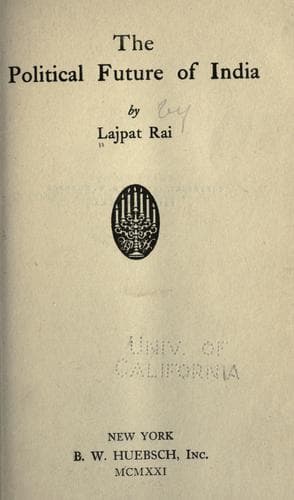
India -- History -- British occupation, 1765-1947; India -- Politics and government -- 1765-1947
On April 9th Sir Michael O'Dwyer, the Lieutenant Governor of the Punjab,
dwelt with pride on the fact that the province ruled by him with an iron
hand for the last five years "had raised 360,000 combatants during the
war." "Dealing with the political situation he declared that the
Government of the province was determined that public order which was
maintained during the war, should not be disturbed during peace. Action
had therefore been taken under the Defence Act against certain
individuals who were openly endeavoring to arouse public feeling against
the Government." It was this action, viz., the summary arrest of
leaders at Amritsar and the order of prohibition against Mr. Gandhi's
contemplated visit to the Punjab, that set fire to the accumulated
magazine. It exasperated the people and in a moment of despair the
intense strain of the last few weeks found relief in attacks on
Government buildings and stray persons of European extraction. What
actually happened in different places no one can definitely tell just at
this stage but it is clear that at places so widely distant as Amritsar
and Lahore in the Punjab and Viramgam in the Gujerat (Western
Presidency) railway stations, telegraph offices and some other public
buildings were burned, railway traffic interrupted, tram cars stopped
and some Europeans killed and attacked. At Amritsar three banks were
burnt down and their managers killed. Telegraphing on April 15th and
again on the 16th of April, the correspondent of the London _Times_
remarked that "the Punjab continued to be the principal seat of trouble"
which was probably due to the extremely brutal methods which the Punjab
Government had followed in repressing and suppressing not only the
present 'riots' but also all kinds of political activity in the
preceding six years. It appears that in about a week's time almost the
whole province was ablaze. The Government used machine guns in
dispersing meetings, showered bombs from aeroplanes and declared martial
law in several towns, extended the seditious meetings prevention Act and
other emergency laws in districts, marched flying military columns from
one end to the other, accompanied by travelling courts martial to try
and punish on the spot all arrested for offences committed in connection
with the passive resistence movement. Leaders were arrested and
deported without trial of any kind; papers were suppressed and all kinds
of demonstrations prohibited.
Public-domain text, read in full here on John Shaqi.
Reviews
Reviews
No reviews yet
Be the first to share your thoughts on this work.
Join the Discussion
Join the discussion
Sign in to leave a comment or review.
Sign InorCreate an account