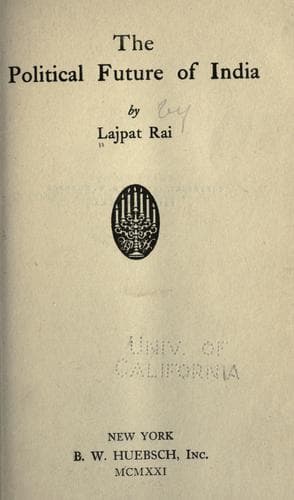
India -- History -- British occupation, 1765-1947; India -- Politics and government -- 1765-1947
"Many of them have adopted our civil and criminal codes. Some have
imitated and even further extended our educational system.... They
have not all been equally able to assimilate new principles. They
are in all stages of development, patriarchal, feudal or more
advanced, while in a few states are found the beginnings of
representative institutions. The characteristic features of all of
them, however, including the most advanced, are the personal rule
of the Prince and his control over legislation and the
administration of justice."
Under the circumstances the question of questions is how these
territories are going to fall into line with the British controlled area
in the matter of the development of responsible Government. We will once
more quote the opinion of the Secretary of State for India and the
Viceroy, who say:
"We know that the States cannot be unaffected by constitutional
development in adjoining provinces. Some of the more enlightened
and thoughtful of the Princes, among whom are included some of the
best known names, have realised this truth, and have themselves
raised the question of their own share in any scheme of reform.
Others of the Princes--again including some of the most honored
names--desire only to leave matters as they are. We feel the need
for caution in this matter. It would be a strange reward for
loyalty and devotion to force new ideas upon those who did not
desire them; but it would be no less strange, if out of
consideration for those who perhaps represent gradually vanishing
ideas, we were to refuse to consider the suggestions of others who
have been no less loyal and devoted. Looking ahead to the future
we can picture India to ourselves only as presenting the external
semblance to some form of 'federation.' The provinces will
ultimately become self-governing units, held together by the
central Government which will deal solely with matters of common
concern to all of them. But the matters common to the British
provinces are also to a great extent those in which the Native
States are interested--defence, tariffs, exchange, opium, salt,
railways and posts and telegraphs. The gradual concentration of
the Government of India upon such matters will therefore make it
easier for the States, while retaining the autonomy which they
cherish in internal matters, to enter into closer association with
the central Government if they wish to do so. But though we have
no hesitation in forecasting such a development as possible, the
last thing that we desire is to attempt to force the pace.
Influences are at work which need no artificial stimulation. All
that we need or can do is to open the door to the natural
developments of the future."
Public-domain text, read in full here on John Shaqi.
Reviews
Reviews
No reviews yet
Be the first to share your thoughts on this work.
Elsewhere in the archive
Join the Discussion
Join the discussion
Sign in to leave a comment or review.
Sign InorCreate an account