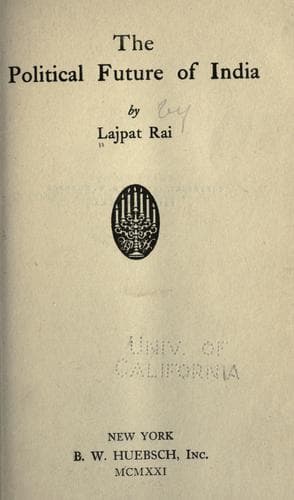
India -- History -- British occupation, 1765-1947; India -- Politics and government -- 1765-1947
In Paragraphs 302 to 305 the authors of the Report state the process by
which this development may be expedited. Disavowing any intention of
forcibly altering treaty rights, they propose to classify the States
into (_a_) those that have "full authority over their internal affairs,"
(_b_) those "in which Government exercises through its Agents large
powers of internal control," (_c_) those who are really no more "than
mere owners of a few acres of land." It is further pointed out that
hitherto the
"general clause which occurs in many of the treaties to the effect
that the Chief shall remain absolute Ruler of his country has not
in the past precluded and does not even now preclude 'interference
with the administration by Government through the agency of its
representatives at the Native Courts.' We need hardly say that
such interference has not been employed in wanton disregard of
treaty obligations. During the earlier days of our intimate
relations with the States British agents found themselves
compelled, often against their will, to assume responsibility for
the welfare of the people, to restore order out of chaos, to
prevent inhuman practices, and to guide the hands of a weak or
incompetent Ruler as the only alternative to the termination of
his rule. So too, at the present day, the Government of India
acknowledges as trustee, a responsibility (which the Princes
themselves desire to maintain) for the proper administration of
States during a minority, and also an obligation for the
prevention or correction of flagrant misgovernment."
And also that:
"the position hitherto taken up by Government has been that the
conditions under which some of the treaties were executed have
undergone material changes, and the literal fulfilment of
particular obligations which they impose has become impracticable.
Practice has been based on the theory that treaties must be read
as a whole, and that they must be interpreted in the light of the
relation established between the parties not only at the time when
a particular treaty was made, but subsequently."
Public-domain text, read in full here on John Shaqi.
Reviews
Reviews
No reviews yet
Be the first to share your thoughts on this work.
Elsewhere in the archive
Join the Discussion
Join the discussion
Sign in to leave a comment or review.
Sign InorCreate an account