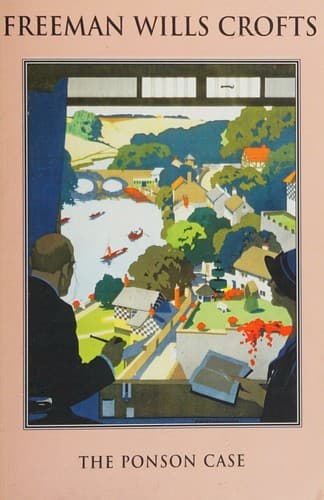
Detective and mystery stories; Murder -- Investigation -- Fiction; Police -- England -- Fiction
His thoughts turned to Cosgrove Ponson. Here was another man who had
an interest in Sir William’s death. And from what Mr Arbuthnot had
said, his interest might be quite as strong, or even stronger, than
Austin’s. When a man about town who had been living a rather fast life
got into financial difficulties, he was not usually very squeamish as
to how he extricated himself. £75,000 to a man perhaps faced with ruin
would be worth taking a risk for. And if Cosgrove had become hardened
enough to commit the crime, he would probably not have jibbed at
making the plant to throw the suspicion on Austin. Tanner concluded
that if Austin’s alibi held, his next work must be the investigation
of Cosgrove’s life as well as his movements on the night of the
murder.
His whole cogitations therefore simply brought him back to the point
from which he had started. Before he did anything else, every point of
Austin’s alibi must be gone into with the most meticulous care.
Accordingly, having refilled his pipe, he set himself to go over in
detail the story Austin Ponson had told him of his movements on the
night of the murder. He wished not only to be clear in his own mind as
to the sequence of events, but to make a list of the points upon which
he could reasonably hope to obtain confirmatory evidence.
Austin, according to his own statement, left the pavilion of the
Halford boat club at about ten minutes before nine. He rowed to the
Old Ferry, sat there for about ten minutes, until the maid arrived
with the note, then walked to the Abbey and spent a few minutes
searching for Miss Drew and her friends. Failing to find them, he went
to the Franklyns’ house, satisfied himself it was empty, returned to
the Old Ferry, and rowed back to Halford, arriving at the pavilion
about quarter before eleven. There he had waked the caretaker to get
the boat in. He had walked to the Drews’, stayed with them some ten
minutes, going on to his own house, which he reached about twenty
minutes past eleven. Now, first, as to the checking of these hours.
Tanner took a sheet of paper, and looking up his note of the times it
had taken him to walk the various distances, and estimating for the
rowing, he made a statement something like a railway time table. When
he had finished he found that the total estimated time which the
journeys should have taken worked out at practically that mentioned by
Austin. So far, then, the story hung together.
Next with regard to outside testimony. What confirmation would it be
reasonable to expect?
Public-domain text, read in full here on John Shaqi.
Reviews
Reviews
No reviews yet
Be the first to share your thoughts on this work.
Join the Discussion
Join the discussion
Sign in to leave a comment or review.
Sign InorCreate an account