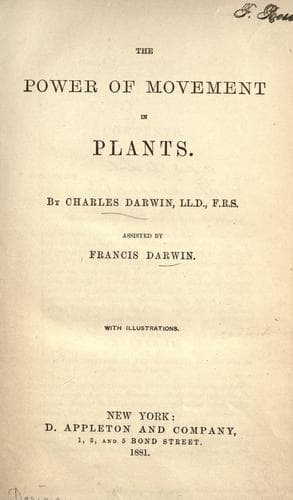
Botany; Geotropism; Plants -- Irritability and movements
As shoots, leaves, etc., in circumnutating bend more and more, first in
one direction and then in another, they were necessarily viewed at
different times more or less obliquely; and as the dots were made on a
flat surface, the apparent amount of movement is exaggerated according
to the degree of obliquity of the point of view. It would, therefore,
have been a much better plan to have used hemispherical glasses, if we
had possessed them of all sizes, and if the bending part of the shoot
had been distinctly hinged and could have been placed so as to have
formed one of the radii of the sphere. But even in this case it would
have been necessary afterwards to have projected the figures on paper;
so that complete accuracy could not have been attained. From the
distortion of our figures, owing to the above causes, they are of no
use to any one who wishes to know the exact amount of movement, or the
exact course pursued; but they serve excellently for ascertaining
whether or not the part moved at all, as well as the general character
of the movement.
In the following chapters, the movements of a considerable number of
plants are described; and the species have been arranged according to
the system adopted by Hooker in Le Maout and Decaisne’s ‘Descriptive
Botany.’ No one who is not investigating the present subject need read
all the details, which, however, we have thought it advisable to give.
To save the reader trouble, the conclusions and most of the more
important parts have been printed in larger type than the other parts.
He may, if he thinks fit, read the last chapter first, as it includes a
summary of the whole volume; and he will thus see what points interest
him, and on which he requires the full evidence.
Finally, we must have the pleasure of returning our
sincere thanks to Sir Joseph Hooker and to Mr. W. Thiselton Dyer for
their great kindness, in not only sending us plants from Kew, but in
procuring others from several sources when they were required for our
observations; also, for naming many species, and giving us information
on various points.
CHAPTER I.
THE CIRCUMNUTATING MOVEMENTS OF SEEDLING PLANTS.
Brassica oleracea, circumnutation of the radicle, of the arched
hypocotyl whilst still buried beneath the ground, whilst rising above
the ground and straightening itself, and when erect—Circumnutation of
the cotyledons—Rate of movement—Analogous observations on various
organs in species of Githago, Gossypium, Oxalis, Tropaeolum, Citrus,
Æsculus, of several Leguminous and Cucurbitaceous genera, Opuntia,
Helianthus, Primula, Cyclamen, Stapelia, Cerinthe, Nolana, Solanum,
Beta, Ricinus, Quercus, Corylus, Pinus, Cycas, Canna, Allium,
Asparagus, Phalaris, Zea, Avena, Nephrodium, and Selaginella.
Public-domain text, read in full here on John Shaqi.
Reviews
Reviews
No reviews yet
Be the first to share your thoughts on this work.
Join the Discussion
Join the discussion
Sign in to leave a comment or review.
Sign InorCreate an account