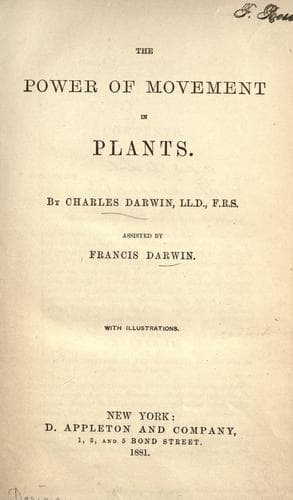
Botany; Geotropism; Plants -- Irritability and movements
In the chapter on Geotropism we shall see that 10 radicles of this
plant were extended horizontally on and beneath damp friable peat,
under which conditions
they grow better and more naturally than in damp air; and their tips
were slightly cauterised on the lower side, brown marks about ½ mm. in
length being thus caused. Uncauterised specimens similarly placed
became much bent downwards through geotropism in the course of 5 or 6
hours. After 8 h. only 3 of the cauterised ones were bowed downwards,
and this in a slight degree; 4 remained horizontal; and 3 were curved
upwards in opposition to geotropism and from the side bearing the brown
mark. Ten other specimens had their tips cauterised at the same time
and in the same degree, on the upper side; and this, if it produced any
effect, would tend to increase the power of geotropism; and all these
radicles were strongly bowed downwards after 8 h. From the several
foregoing facts, there can be no doubt that the cauterisation of the
tip of the radicle of this Cucurbita on one side, if done lightly
enough, causes the whole growing part to bend to the opposite side.
Raphanus sativus: Sensitiveness of the apex of the Radicle.—We here
encountered many difficulties in our trials, both with squares of card
and with caustic; for when seeds were pinned to a cork-lid, many of the
radicles, to which nothing had been done, grew irregularly, often
curving upwards, as if attracted by the damp surface above; and when
they were immersed in water they likewise often grew irregularly. We
did not therefore dare to trust our experiments with attached squares
of card; nevertheless some of them seemed to indicate that the tips
were sensitive to contact. Our trials with caustic generally failed
from the difficulty of not injuring too greatly the extremely fine
tips. Out of 7 radicles thus tried, one became bowed after 22 h. at an
angle of 60°, a second at 40°,
and a third very slightly from the perpendicular and from the
cauterised side.
Æsculus hippocastanum: Sensitiveness of the apex of the Radicle.—Bits
of glass and squares of card were affixed with shellac or gum-water to
the tips of 12 radicles of the horse-chestnut; and when these objects
fell off, they were refixed; but not in a single instance was any
curvature thus caused. These massive radicles, one of which was above 2
inches in length and .3 inch in diameter at its base, seemed insensible
to so slight a stimulus as any small attached object. Nevertheless,
when the apex encountered an obstacle in its downward course, the
growing part became so uniformly and symmetrically curved, that its
appearance indicated not mere mechanical bending, but increased growth
along the whole convex side, due to the irritation of the apex.
Public-domain text, read in full here on John Shaqi.
Reviews
Reviews
No reviews yet
Be the first to share your thoughts on this work.
Elsewhere in the archive
Join the Discussion
Join the discussion
Sign in to leave a comment or review.
Sign InorCreate an account