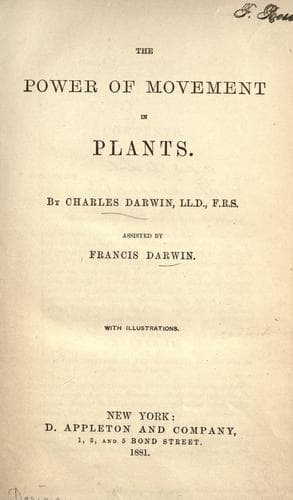
Botany; Geotropism; Plants -- Irritability and movements
[11] See his valuable article in ‘Bot. Zeitung,’ 1867, p. 257, on
these monstrous growths, which are called in German “Hexenbesen,” or
“witch-brooms.”
According to Mr. Meehan,[12] the stems of three species of Euphorbia
and of Portulaca oleracea are “normally prostrate or procumbent;” but
when they are attacked by an Æcidium, they “assume an erect habit.” Dr.
Stahl informs us that he knows of several analogous cases; and these
seem to be closely related to that of the Abies. The rhizomes of
Sparganium ramosum grow out horizontally in the soil to a considerable
length, or are diageotropic; but F. Elfving found that when they were
cultivated in water their tips turned upwards, and they became
apogeotropic. The same result followed when the stem of the plant was
bent until it cracked or was merely much bowed.[13]
[12] ‘Proc. Acad. Nat. Sc. Philadelphia,’ June 16th, 1874, and July
23rd, 1875.
[13] See F. Elfving’s interesting paper in ‘Arbeiten Bot. Institut.,
in Würzburg,’ vol. ii. 1880, p. 489. Carl Kraus (Triesdorf) had
previously observed (‘Flora,’ 1878, p. 324) that the underground
shoots of Triticum repens bend vertically up when the parts above
ground are removed, and when the rhizomes are kept partly immersed in
water.
No explanation has hitherto been attempted of such cases as the
foregoing,—namely, of secondary radicles growing vertically downwards,
and of lateral shoots growing vertically upwards, after the amputation
of
the primary radicle or of the leading shoot. The following
considerations give us, as we believe, the clue. Firstly, any cause
which disturbs the constitution[14] is apt to induce reversion; such as
the crossing of two distinct races, or a change of conditions, as when
domestic animals become feral. But the case which most concerns us, is
the frequent appearance of peloric flowers on the summit of a stem, or
in the centre of the inflorescence,—parts which, it is believed,
receive the most sap; for when an irregular flower becomes perfectly
regular or peloric, this may be attributed, at least partly, to
reversion to a primitive and normal type. Even the position of a seed
at the end of the capsule sometimes gives to the seedling developed
from it a tendency to revert. Secondly, reversions often occur by means
of buds, independently of reproduction by seed; so that a bud may
revert to the character of a former state many bud-generations ago. In
the case of animals, reversions may occur in the individual with
advancing age. Thirdly and lastly, radicles when they first protrude
from the seed are always geotropic, and plumules or shoots almost
always apogeotropic. If then any cause, such as an increased flow of
sap or the presence of mycelium, disturbs the constitution of a lateral
shoot or of a secondary radicle, it is apt to revert to its primordial
state; and it becomes either apogeotropic or geotropic, as the case may
be, and consequently grows either vertically upwards or downwards. It
is indeed
Public-domain text, read in full here on John Shaqi.
Reviews
Reviews
No reviews yet
Be the first to share your thoughts on this work.
Elsewhere in the archive
Join the Discussion
Join the discussion
Sign in to leave a comment or review.
Sign InorCreate an account