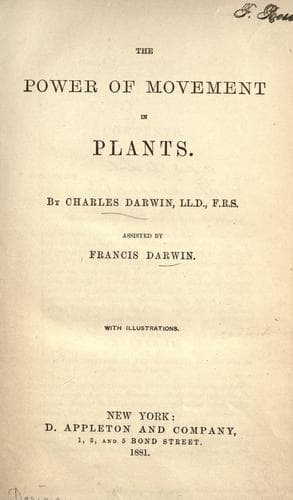
Botany; Geotropism; Plants -- Irritability and movements
Rate of Movement.—The movements of the hypocotyls and cotyledons of
seedling cabbages of different ages have now been sufficiently
illustrated. With respect to the rate, seedlings were placed under the
microscope with the stage removed, and with a micrometer eye-piece so
adjusted that each division equalled 1/500 inch; the plants were
illuminated by light passing through a solution of bichromate of
potassium so as to eliminate heliotropism. Under these circumstances it
was interesting to observe how rapidly the circumnutating apex of a
cotyledon passed across the divisions of the micrometer. Whilst
travelling in any direction the apex generally oscillated backwards and
forwards to the extent of 1/500 and sometimes of nearly 1/250 of an
inch. These oscillations were quite different from the trembling caused
by any disturbance in the same room or by the shutting of a distant
door. The first seedling observed was nearly two inches in height and
had been etiolated by having been grown in darkness. The tip of the
cotyledon passed across 10 divisions of the micrometer, that is, 1/50
of an inch, in 6 m. 40 s. Short glass filaments were then fixed
vertically to the hypocotyls of several seedlings so as to project a
little above the cotyledons, thus exaggerating the rate of movement;
but only a few of the observations thus made are worth giving. The most
remarkable fact was the oscillatory movement above described, and the
difference of rate at which the point crossed the divisions of the
micrometer, after short intervals of time. For instance, a tall
not-etiolated seedling had been kept for 14 h. in darkness; it was
exposed before a north-east window for only
two or three minutes whilst a glass filament was fixed vertically to
the hypocotyl; it was then again placed in darkness for half an hour
and afterwards observed by light passing through bichromate of
potassium. The point, oscillating as usual, crossed five divisions of
the micrometer (i.e. 1/100 inch) in 1 m. 30 s. The seedling was then
left in darkness for an hour, and now it required 3 m. 6 s. to cross
one division, that is, 15 m. 30 s. to have crossed five divisions.
Another seedling, after being occasionally observed in the back part of
a northern room with a very dull light, and left in complete darkness
for intervals of half an hour, crossed five divisions in 5 m. in the
direction of the window, so that we concluded that the movement was
heliotropic. But this was probably not the case, for it was placed
close to a north-east window and left there for 25 m., after which
time, instead of moving still more quickly towards the light, as might
have been expected, it travelled only at the rate of 12 m. 30 s. for
five divisions. It was then again left in complete darkness for 1 h.,
and the point now travelled in the same direction as before, but at the
rate of 3 m. 18 s. for five divisions.
Public-domain text, read in full here on John Shaqi.
Reviews
Reviews
No reviews yet
Be the first to share your thoughts on this work.
Join the Discussion
Join the discussion
Sign in to leave a comment or review.
Sign InorCreate an account