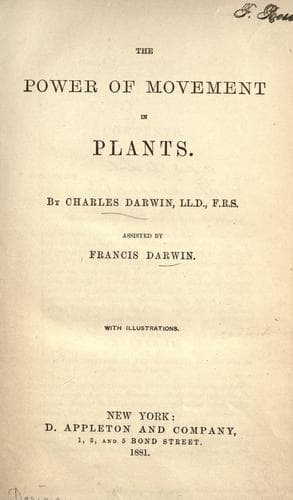
Botany; Geotropism; Plants -- Irritability and movements
[1] Dassen,’Tijdschrift vor. Naturlijke Gesch. en Physiologie,’ 1837,
vol. iv. p. 106. See also Ch. Royer on the importance of a proper
state of turgescence of the cells, in ‘Annal. des Sc. Nat. Bot.’ (5th
series), ix. 1868, p. 345.
[2] ‘Beiträge zur Kentniss der Bewegungen,’ etc., in ‘Flora,’ 1879,
pp. 42, 43, 67, etc.
[3] ‘Annal. des Sc. Nat. Bot.’ (5th Series), ix. 1868, p. 366.
We will now give our observations on sleeping plants, made in the
manner described in the Introduction. The stem of the plant was always
secured (when not stated to the contrary) close to the base of the
leaf, the movements of which were being observed, so as to prevent the
stem from circumnutating. As the tracings were made on a vertical glass
in front of the plant, it was obviously impossible to trace its course
as soon as the leaf became in the evening greatly inclined either
upwards or downwards; it must therefore be understood that the broken
lines in the diagrams, which represent the evening and nocturnal
courses, ought always to be prolonged to a much greater distance,
either upwards or downwards, than appears in them. The conclusions
which may be deduced from our observations will be given near the end
of this chapter.
In the following list all the genera which include sleeping plants are
given, as far as known to us. The same arrangement is followed as in
former cases, and the number of the Family is appended. This list
possesses some interest, as it shows that the habit of
sleeping is common to some few plants throughout the whole vascular
series. The greater number of the genera in the list have been observed
by ourselves with more or less care; but several are given on the
authority of others (whose names are appended in the list), and about
these we have nothing more to say. No doubt the list is very imperfect,
and several genera might have been added from the ‘Somnus Plantarum’ by
Linnæus; but we could not judge in some of his cases, whether the
blades occupied at night a nearly vertical position. He refers to some
plants as sleeping, for instance, Lathyrus odoratus and Vicia faba, in
which we could observe no movement deserving to be called sleep, and as
no one can doubt the accuracy of Linnæus, we are left in doubt.
[List of Genera, including species the leaves of which sleep.
CLASS I. DICOTYLEDONS.
Sub-class I. ANGIOSPERMS.
Genus Family.
Public-domain text, read in full here on John Shaqi.
Reviews
Reviews
No reviews yet
Be the first to share your thoughts on this work.
Elsewhere in the archive
Join the Discussion
Join the discussion
Sign in to leave a comment or review.
Sign InorCreate an account